Monday, November 18, 2019

Changing the tide

My perception on student achievement and learning has been challenged this year. Challenged in way where I am starting to look at the program that is offered for Level 3 English and I am starting to think what is going on? The program for Level 1 and Level 2 English are at the place where student achievement and engagement is good, not great but definitely not in crisis. For Level 3 English, I have noticed that our students are not where they should be.

I have started to look at the current program for Level 3 English. At this stage we offering the following assessments:

  • 91480 - Close Viewing - 3 Credits
  • 91475 - Writing Portfolio - 6 Credits
  • 91478 - Connections Report - 4 Credits
  • 91476 - Speech - 3 Credits
  • 91479 - Critical Analysis of texts - 3 Credits

My view is that there is an assessment overload and that there are two assessments that our students' are not engaged with. In my planning for next year, I am hoping on cutting down on what is not needed and focus on what is working and how I can deliver it as best as I can for our students.

My plan for next year is to remove:

  • 91479 (Critical Analysis of texts) - I believe that the analysis of texts at a critical level is already happening with through our Extended text and Visual text study. There is no need to double hand students with assessments. 
  • 91476 (Speech) - I believe that rich discussions should be happening in the classroom. Students should not be assessed on something that we should be doing in the classroom already. 


This leaves 91480, 91475 and 91478 as the remaining assessments. One assessment per term, this implies that the quality of the assessment is given time and the students can take their time and not rush through the assessment. This also implies that the expectation is that they do pass the assessment given the healthy time to discuss, learn, share and create in class.

Tuesday, September 10, 2019

Boys in Literacy

Ms George and I attended the 'Boys in Literacy' PD lead by Marshall Diggs. Here are some of the gems that I took away from the PD. It was informative
and very good!

1) LEARNING IS MORE IMPORTANT THAT THE RESULT - this was a phrase repeated throughout the PD. Sometimes as educators we can lost in the pace of assessments and deadlines that the learning can take a backseat. This phrase made me think about this very thing, what is essential in a student's learning journey - is it the number of credits or the skill and learning?

2) DON'T DUMB DOWN THEIR GIFT - When you over scaffold it can stifle the learning, they write bits of everything with no substance - This has made me think about my the scaffold practices that I give to my boys. I need to review as I want my boys to feel empowered with their own writing. I will help them as best as I can but I do not want to baby them through writing. I want them to feel free and empowered to use their voice in their writing.
Boys engage when writing tasks involve:

  • Facts - what are the facts - compare and contrast the facts around the setting and compare to the conflict in the text
  • Competition
  • Humor
  • Survival - The Cay (Theodore Taylor) links to survival/description of survival type writing
  • Conflict - Write about the conflict with the Titans and the Olympians and the radical conflict in the text
  • Adventure
  • Overcoming adversity - write about an experience when you overcame adversity - link to the film Wonder (Julia Roberts) 
  • Socially engineer the choices boys have when it comes to writing. 
  • Writing is about QUALITY not QUANTITY

3) SAFE SPACE - Boys thrive in a structured learning environment - they feel safe and feel free from the put down of peers. 

4) EFFECTIVE PEDAGOGY - Effective pedagogy is about connecting and building relationships.
Always speak clearly, maintain eye contact, wait for compliance, repeat and estate instructions - never rephrase, use of inclusive language is not helpful - give the boys the headline not the paragraph. Boys respond best when there is visual representations (LADS - Listen and Draw Something) and when we de-escalate tension - go shoulder to shoulder before you go face to face.

Final take away quotes that stood out for me: 
"Refuse to lower your standards to accommodate those who refuse to raise theirs" - Mandy Hale
"Speak to the boy before you speak to the issue" - Marshall Diggs
"Greatest contribution to the sector is not what you teach but who you teach" - Marshall Diggs

Monday, September 9, 2019

Reflection: Quality over Quantity

Sometimes we can be overloaded with information and advice on how to accelerate student achievement. A few questions that have helped me to filter through the information and really hone in what I think is essential in my journey, has brought a real sense on what is important for me. Quality over quantity.

Student Feedback: 
What are the three important things I would like my teacher to do help me learn?
Explain, one on one teaching, competition, interact, rewards
What helps me think for my learning?
Music, food, talking, space, breaking it down into easy steps/chunks, acknowledging progress


Points for educators to think about in response to student feedback
Quality of Professional Learning Conversations
Low Quality: 
  • Considerable talk about student behavior
  • Talk about teaching without connecting it to evidence of impact on the student's understanding of learning
  • Talk about the data for the purpose of grouping students
  • Talk about the data for the purpose of singling out teachers for for praise or criticism
High Quality: 
  • Focus on student learning and engagement, surfacing challenging issues of practice
  • Talk that uses evidence as a basis for collective inquiry into relationships between teaching and learning. Talk driven by a desire to learn
  • Talk that uses data for the purpose of designing more effective teaching approaches and interventions
  • Use data to learn about effective practice
What are some 'High Quality' learning conversations about particular students that I can lead in my department?
  • Leading Partnerships
  • Learners are active participants
  • What are learners good at? Build on their strengths
  • Who are they? See the learner
  • Doing with them, not to them
  • Setting goals and developing new relationships
  • Ongoing sharing
  • Celebrating successes
  • Summarizing learning progress at key points in time to illuminate what has been learnt and inform future learning
  • Parents and whanau would like more information about their child's progress, including how they can support their child's learning

Leadership of sticky change: Fullan
  • Use the group to change the group
  • Precision over prescription
  • Feedback candor and autonomy
  • See the forest and the tress
  • Accountability as culture
Acceleration by design: 
Knowing your learners
  • Tailoring teaching and assessments for individuals and groups
  • Engaging with students' cultures and identities
  • Adapting for students' literacy needs
  • Adapting for students' attendance needs
  • Involving whanau
Collaborating with students
  • Providing choices for teachers, programs and assessments modes
  • Being explicit
  • Learning together with students
  • Empowering students to take the lead in learning
Some ideas on involving students in their accelerated programs: 
  • Speak with the students
  • Breaking down into achievable steps - what is achievable?
  • Looking at completing unfinished assessments
  • Precise feedback
  • Asking the student to come with work they are confident in completing 

Monday, August 12, 2019

Where to from here?

After the department presentations (which I thoroughly enjoyed) the Ministry suggested the following options that help middle leaders and their departments' in accelerating student achievement.
  • Intensives - Pulling the students out of class do assessments
  • Value of feedback and feed forward
  • Tailoring our programs that we offer - know who the cohort is and build on their strengths
  • Being responsive to the student's needs
  • Departments collaborating - teachings collaborating together - identify at risk students and focus on what is/not working
  • Short term goal (quick sustainable goals) - Intensive classes
  • Long term goal (long term planning) - thematic programs for each class/cohort
Ultimately the running of the department should follow the Lencioni Triangle - which focuses on improving team alignment and performance. 


Wednesday, July 24, 2019

Leading the change

An important lesson that I have learnt when it comes to leadership is that there is value and power in sharing and collaborating. Each of the learning areas were asked to present on how they are leading change in their departments and what they are doing in regards to student achievement. It was enlightening and encouraging to see and hear what my colleagues are doing with their team and students. Here is some of my takeaway from the presentations: 

Technology Department: The Tech Dept have responded to achievement of their students' through continual consultation. A reflection and inquiry on what the policy or process is for students' who do not meet credit protocol.
Science Department: The department are encouraged to prioritize relationship building with students as an important factor in student achievement. 
PE Department: The department credits by attaching assessments to other assessments to make it fit for the learner. Target students are constantly changing based on student's attendance, performance and completion of assessments. 
Visual Arts Department: The department shared that they want to main the current strategies used for accelerating student achievement. They also want to ensure that the senior student's are committed to the subject, provide adequate exemplars and continue feedback. 
Te Reo Maori Department: The desired outcome for all students' is to build confidence in Te Reo Maori and to engage in more explicit learning conversations with the students. 
Social Sciences Department: The Social Science Department want the students to be excited and engaged in Social Sciences. In terms of support for their target group of students' is to have intense and purposeful discussions, goal setting and understanding what motivates the student. 
ESOL Department: The desired outcome is for each student to gain credits from three standards offered in ELIP. Moving forward, relationship building and having those intense conversations is needed.  
Music Department: The course of action to help student achievement is to tailor the program to fit the student's strengths by using song writing, performance and group based activities. 
Mathematics Department: Desired outcomes to support achievement are to continue to use literacy strategies, collaborative inquiry and looking at the data closely. 

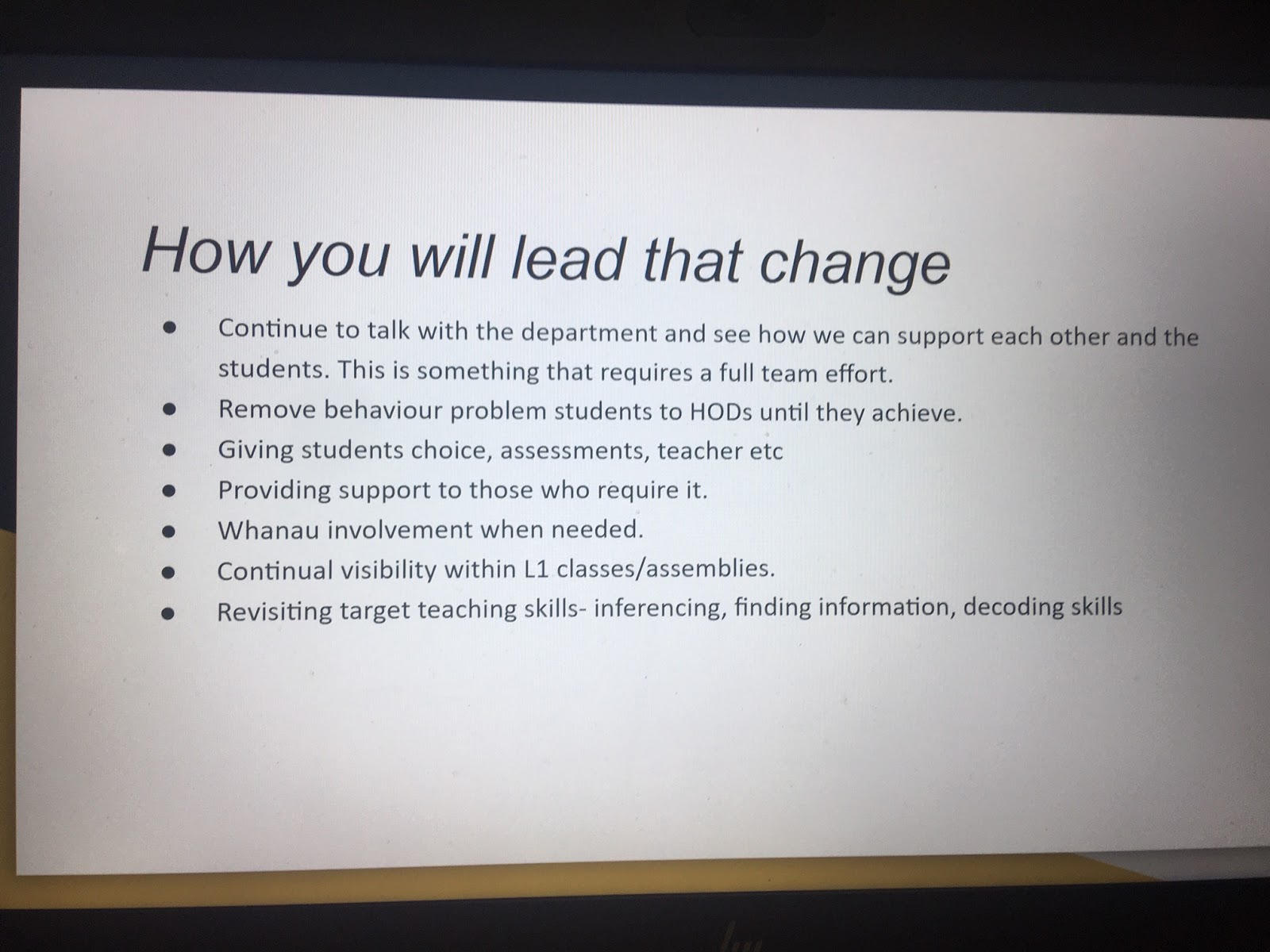
Here is the strategies from the English Department: 


Monday, June 24, 2019

Student Centered Leadership - Going further.

Our 'Why':
Revisiting our 'why' is important when you are working on making your leadership more centered around students' needs. As a department, our 'why' is focusing on the students we care for. They are the participants and benefactors of our work as leaders and teachers. 

Our 'What':
The collective goal for the English department this term is to accelerate the achievement of Year 11 students. Here a few questions that helped me reflect on what my colleague, Ms Amber George and I have achieved with the department so far with our Year 11 students. 
  • What was your deliberate act of leadership? Following up with the department, being more visiable to the students, talking with the students and having restorative conversations. 
  • What was the outcome? Credit shift (gaining more credits through intervention), there is a long way to go but the improvement promising. 
  • What did you learn? To be patient with the process, to fix what is not working straight away and the importance of clarity in communicating our expectations to the department. 

Student Voice (What the young people are saying): 
The students' were able to share their thoughts on what they want from their teachers. 

The findings is a result from conversations that were held with senior students (Year 11, 12 and 13). This is some of their responses:

  • Listen to what we want to achieve 
  • Push us to get endorsements
  • Know our skill set and abilities 
  • Comfortable environment 
  • Make our parents proud 
  • Fun work
  • Don't talk a lot
  • Explain what we need to do to get merit and excellence
  • Slow down and explain 
  • Respectful environment

Critical Perspective: 
Barbara Alaalatoa (Principal of Sylvia Park School) states that “Teachers who are connected to and know the students deeply”, “Authentically build their teaching practice around the student”, “Committed to learning about their craft and their learners” and “They make no assumptions about the learners in front of them”

The Bigger Picture: 
Viviane Robinson states "The more leaders focus on their relationships, their work, and their learning on the core business of teaching and learning, the greater their influence on student outcomes." When thinking about the bigger picture with student centered leadership, I have learnt that one of the core jobs of a middle leader is to lead the learning of the department. As middle leaders it is vital that we help to translate teaching practice into the classroom and ultimately effect and influence the team and students. 

What does effective teaching look like?
Effective teaching is collaboration with colleagues, strength based learning with a focus on students needs. The relationship with the student is an integral part in effective teaching. 
It is a commitment to the student, I believe that when you are committed to the student then you are open to change, learning, evolving and not staying static. 


Monday, June 10, 2019

Student Centered Leadership: What does it mean?

What does student centered leadership mean?

Student centered leadership can mean many things. For myself I believe that student centered leadership looks like:

Self-directed learning
My goal for my Level 3 students this year to design a program where they drive what they want to do with their writing assessments. I am looking forward to working with Cynthia Orr (Team Solutions) who will help me put this program together. I believe that if the students find texts that they are interested in, their response to the text will be more genuine. Watch this space!

Learning needs of the students drive the learning objective
Teachers taking note of the student and their needs and adjusting their program to the need. I have spoken about this before, this is something I support and endorse.

Sharing of power in the classroom
We as educators can learn so much from our learners. This is something that I am interested in pursuing. There is so much value in what our students bring to the classroom and this can be utilized in way that will enrich the classroom experience for everyone involved. I am wanting to inquire in what has worked for our students who have achieved exploring what helped them succeed and how they applied this to their studies. 

Tom Webb states student centered leadership is "leadership that makes a difference to the equity and excellence of student outcomes". Education is a source of equity for our young people. If our focus is on making the learning needs the priority and encourage the sharing of power with our learners, our leadership will be one where it is not only leading from the front but from all areas. 


Week 9 Term 3 - Teacher Practice: Understanding Character - 91925 Character Essay (September 14 - September 18)

Character Profile  This essay plan is designed to help you dig deep into the characters of The Dark Horse. It kicks off by setting the stage...