Sunday, July 30, 2023

Week 3 Term 3 - Teacher Practice: New Literacy CAA Standard - Preparing our students for the new standard (July 31 - August 04)

THE JOURNEY SO FAR

The new curriculum refresh roll out is around the corner. From 2024 the new NCEA Level 1 curriculum will begin and the new set of standards will be released. In 2021, the English Department has started to look at and unpack the new NCEA Level 1 English internal and external standards. We have a fair idea on what each standard is and how we want to integrate that into our existing NCEA Level 1 English program. Since our initial discussion in 2021, we have had productive planning meetings and sessions, unpacking and exploring the curriculum for NCEA Level 1 English. I have reflected this in my earlier blog posts. 

Alby's Blog Entry Post - 30/04/23

Alby's Blog Entry Post - 13/11/22

Alby's Blog Entry Post - 24/08/22

Alby's Blog Entry Post - 16/05/22

I look forward to reflecting and documenting the progress that has been made since our last look at the new curriculum in April. The new curriculum sees a significant change in how many credits that they students need to achieve to gain NCEA Level 1 - with less assessments which means less pressure on students to produce and more of a focus on the learning and creating. In 2024 NCEA 1 changes are as follows: 

  • To gain Level 1 you will need 60 credits from a set of new achievement standards
  • 10 credit literacy co-requisite
  • 10 credit numeracy co-requisite

If a student does not achieve the 10 credits Literacy or Numeracy co-requisite, they cannot pass NCEA Level 1. The 10 credits for Literacy and Numeracy are separate to the 60 credits so students need to pass both the 10 Literacy and Numeracy co-requisite credits and the 60 credits (80 in total). Currently students must pass 80 credits (10 Literacy + 10 Numeracy credits) are inclusive in the total 80 credits. The changes to the new NCEA refresh for Level 1 are big and it does change the course of how we are currently doing things. 

WHERE ARE WE NOW?

Literacy Group with Mr Milford Week 2 Term 3

We have started the journey in looking and drafting a plan for the new NCEA Level 1 English refresh. My focus now is on the Literacy CAA Co-Requisite assessment. This year I have decided to do a trial run of the new Literacy CAA Co-Requisite assessment. I have selected 21 students from our current Year 10 Cohort who achieved between high Level 4 to low Level 5 for asTTle Writing (Term 1). It has been suggested in the feedback from the pilot schools that students who are at high Level 4 to low Level 5 for asTTle Writing are encouraged to do the co-requisite assessment. In our current cohort of Year 10, we have 21 students who are at the appropriate level. I have linked in the two assessments that (Unit Standards) the students will be sitting in Term 4. 

This term, we have started to prepare the students for the assessment. We meet with the students once a week (hopefully we can meet with them twice a week closer to the assessment date in Term 4). For now, we meet with them on Monday in the afternoon. Mr Marc Milford (literacy expert) and I are working with this group. We are building the unit as we go, but we have an idea on what we want to do over the next 7 weeks in Term 3. 

We have decided to take a thematic approach to the preparation. Instead of just giving our students random reading and writing tasks, we wanted to hone it in and provide a more structured program that focuses on a topic or theme. The theme that we have chosen is Our Community, The Community. The inspiration around this is based on the community facility prompt that the students chose for the asTTle Writing Term 1 program and also there was a community focus in both the reading and writing pilot that took place in 2022 and the beginning of 2023. The topic is broad enough to pull on student's experiences and we can create or gather resources that are readily available to us. 


Reading Focus: 
  • Get a range of texts (Continuous + non-continuous) and also pulling exemplars from asTTle to unpack with the students. 
  • Vocabulary - look at meaning of words from a text (academic/vocab lists) look at meaning for the words from the sentence, context definition for the word, word attack skills - there is a method of working out the sentence to find out what the word means, find clues within the word to find out the meaning of the word 
  • What we need to focus on - Reading Assessment Specifications
  • Do reading intensive for x2 weeks focusing on - Who wrote this text? Why did they write this text? Who did they write this for?

Writing Focus: 
  • Follow up with a writing task (see writing task below) x2 weeks
  • What we need to focus on - Writing Assessment Specifications
  • Candidates will be required to produce two pieces of writing in response to stimulus material chosen from a range of options provided by NZQA. The two pieces will be of different text types, and one will be in a formal register. Text types may include (but are not limited to): letters, reports, articles, blog posts, profiles, descriptions, explanations, and opinions.
  • Write - linked to themes from the assessment
  • Differentiated writing tasks -
  • Writing a letter (formal letter)
  • Peer review writing

Our plan for Term 3 is: 
  • Week 3 - Our Community - Reading (asTTle Letter exemplar 1)
  • Week 4 - Our Community - Reading (asTTle Letter exemplar 2)
  • Week 5 - Our Community - Writing task (write a letter)
  • Week 6 - Our Community - Writing task (write a letter)
  • Week 7 - The Community - Reading - ask for P4 Monday for x2 reading periods
  • Week 8 - The Community - Writing - ask for P4 Monday for x2 writing periods
  • Week 9 - Practice Test
  • Week 10 - Feedback to students 

Everything about this learning program is new. I am open to and embracing the journey, a journey I will be learning WITH the students. I am looking forward to seeing how each week goes and in particular I am looking forward to the practice test in Week 9. That will tell me where the students are at and what next steps we need to take going in Term 4 in the last weeks before the actual assessment (slated for November). I also look forward to documenting the journey and sharing it with the English Department. I am hoping that once the trial is done, I can share the unit and the learning with the Department so that they can work through this with their Year 10 and Year 11 cohort next year. 

Sunday, July 23, 2023

Week 2 Term 3 - Teacher Practice: Inquiry 2023: Term 2 Reflection + Term 3 Goal Setting (July 24 - July 28)

My inquiry journey in Term 2 was awesome. I really enjoyed the learning experience with my inquiry and in particular with my focus group - 9TKl. I felt the need to reflect on the journey with the students, before we venture into the program for Term 3. 

Starting the new school term with the right attitude, spirit and mindset was the focus for the inquiry and inquiry group (9TKl). This week we spent two sessions going through our Term 2 Reflection + Term 3 Goal Setting Document. The purpose of this document is to: 
  1. Get the student to review their learning journey by accessing their learning achievement data online (via KAMAR Student Portal)
  2. Reflect on their learning journey
  3. Set goals for the term
I created this document last year and used it with my junior class. I made some adjustments to the document, so that the student can dig deep into their learning journey and unpack it to see what it means for them. We spent our afternoon class on Tuesday going through the document, the students went through the document individually. On Wednesday, the students got into pairs and shared their reflections with each other. The were given the task to provide positive and affirming verbal feedback. The students were able to learn about their peers and also affirm their reflection and goals. 

I will explain the three parts of the reflection/goal setting document and what it is about. Then I will share some highlights from my student's responses. 

LEARNING JOURNEY REFLECTION: Results


I believe that it is important to know your learning journey and what you have achieved in the journey. It helps to give both kaiako and akonga a sense of grounding and an idea of what they have been able to accomplish. It is important for my students to know their learning map and to see what they have been able to cover over the year. 
Term 2 Reflection: Looking at their learning and results. 

In Week 1 of Term 3, the students looked back at their results from Term 1 and Term 2 English. They did this by logging into our student portal where they can see their current results across all of their subjects. This is readily available for our akonga at any time but for the most part, they do not engage with it. I wanted to use the time at the beginning of the term for the students to have a look at what they have done and achieved ultimately to appreciate their progress and journey. 

Here are some responses from my inquiry group. 

"The curriculum level that I need to be at is Level 4. The curriculum level that I am at for this is level 4. I am happy with this because I am always happy to see good grades. I know getting a level 4 is standard but I want to push myself in reading to get a higher mark."

This level was the best for me cause i made an easy formal writing.

"The curriculum level that I need to be at is Level 5.
The curriculum level that I am at for this is Level 4.
I am happy with this because this is the level I should be at.
What I want to do to improve is study more at home and manage my time."


LEARNING JOURNEY REFLECTION: Academic Reflection


Here the students were able to delve into their reflection and talk about what worked and what did not work. They were able to review this and revisit the steps that helped them to achieve but also be aware of the barriers to their learning. 
Term 2 Reflection: Reflection on their learning achievement and challenges
Here are some responses that were highlighted for me. 

"What did you enjoy about school in Term 2? Why?
I liked how everyone was used to everyone and was comfortable
What didn’t you like about school in Term 2? Why?
I didn’t like some of the subjects and teachers but I settled in
What can you do to improve in school in Term 3?
My learning and to improve all my skills in learning and to stay on task""

"What did you enjoy about school in Term 2? Why?
I really enjoyed term 2 because I got to know my peers a lot more than I already knew .
What can you do to improve in school in Term 3?
I want to improve on all of my subjects"

LEARNING JOURNEY REFLECTION: Personal Goals


Setting goals gives you a finish line to work towards. Although reflecting and setting goals is something that my students seldom do, bringing the practice and language around it can help and open them up to it. Also intentionally asking them questions where they have to think about their intention, how they see themselves - can help them really understand the power that they have in their own learning. 
Term 2 Reflection: Personal Goals

 Here are some of the highlights from my student's responses. 

"What did you learn about yourself last term?
I learnt that I need to work harder in certain subjects to get better marks
What did you learn about yourself as a learner last term?
I learnt that I can get very good marks if I stay focus but I also if I can maintain great work ethic as well
What is something that you did last term that you liked or that you are really proud of? Why?
Although I didn’t do so well in my reading test I was very proud of my writing results cause I now will try very hard to maintain a level 5
What are your goals for Term 3?
If we have exams I want to achieve high and if we don’t I want all of my work to be at above standard or at its very best ethic. I want to change my perspective towards school by prioritizing my time at home as well as in a school environment."

As we launch into our new unit of learning for Term 3 (Visual Text Study) I wanted to stop and spend time reflecting with the students. I enjoyed doing this activity with them and I also enjoyed seeing them interact and affirm each other when they were reading each other's reflections. 

Next steps - Week 3 - Week 5: 
  • Start Visual Text Study - x1 short film and x1 full film study
  • Learn visual techniques + effects. 
  • Assessment: Close Viewing

Sunday, July 16, 2023

Week 1 Term 3 - English Department: Term 2 Review + Plan for Term 3 (July 17 - July 21)

Term 2 was a challenging term to say the least. As a department and as a school, we were teaching in a time where PPTA Strike Action was taking place and our students were in and out of school. Despite all the challenges that we faced, we finished the term well. I would like to thank the entire English Department team - Ms Anahina Latu, Mrs Pravina Harde, Mrs Christine Williams, Mr Faiyaz Hoosein, Mr Jeremy Spruyt, Ms Francis Kolo, Mr Marc Milford, Mrs Viviene Jenson-Jones and Dr Jannie Van Hees - thank you for your time, hearts, commitment and service to the English Department and to your students. My job is made so much easier because of you. Thank you all!

Here are some highlights for the English Department Term 2.

  • English Department Monday morning (Term 2) - We have enjoyed our Monday morning meetings during Hybrid learning. It is a time for us to come together and to regroup. It has been helpful for us to get on to the same page, to learn from each other and share in each other’s journey throughout the term.

  • Teacher Only Day (Week 6 Term 2 - June 2 2023) - The Manaiakalani Cluster Teacher Only day took place at the end of Week 6 Term 2. The primary focus of the TOD was 'CREATE' specifically 'Creativity Empowers Learning' - For Manaiakalani Create/Hanga is built on engagement and empowerment. How are we harnessing Create to motivate our learners to ENGAGE with reading to learn and learning to read?

  • Teacher Only Day (Week 2 Term 2 - May 1 2023)  For our most recent TOD, we used this time to focus on the changes to NCEA Level 1 English program and to continue our discussion around the new achievement standards. We spent time revisiting the new achievement standards that we covered in 2022 and also explored the new external assessments that are on offer. We were able to do this as well as flesh out a draft plan for our new NCEA Level 1 English program 2024. We used TOD to feedback about the external assessments. Much like what we covered last year, the department looked at the same five areas when unpacking the assessment -
  1. What is the assessment?
  2. Keywords and concepts from the assessment
  3. Opportunities
  4. Potential barriers
  5. Next steps
The department was broken up into two groups - each group looking at the new achievement standards (1.3 and 1.4).

We will now review our Term 2 Junior and Senior English program.

JUNIOR ENGLISH PROGRAM TERM 2 REVIEW: 
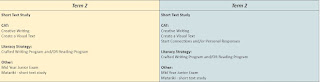
Junior English Program Term 2


Our focus for Year 9 and Year 10 English was Short Text. We spent the term going through our first text study for 2023. Some of the texts that were covered this term were:
  • Jillian Sullivan - Dear Ex Dad (Year 9 English)
  • Alicia Keys - P.O.W (Year 9 English)
  • Witi Ihimaera - Big Brother Little Sister (Year 9 + Year 10 English)
  • Andy Mulligan’s - Trash (Year 10 English)
Following the short text study, our students worked on our CAT (Common Assessment Task) Creative Writing. The students were engaged with the Creative Writing CAT and we are pleased with the results. We are hoping to close the loop with students who were not able to complete it during the first week of Term 3.

Below are some examples of the creative writing from our akonga. Their understanding on how to craft a creative text and how they used their narrative voice was impressive.
Student exemplar 1 - Creative Writing Tamaki College Term 2

Student exemplar 2 - Creative Writing Tamaki College Term 2
 

SENIOR ENGLISH PROGRAM TERM 2 REVIEW


Senior English Program Term 2

The focus for Term 2 for our NCEA Level 1, 2 and 3 students was the Extended Text Study. For NCEA Level 1 English we focused on John Steinbeck’s ‘Of Mice and Men’, for NCEA Level 2 English we focused on Doris Lessings ‘The Grass is Singing’ and for NCEA Level 3 English we focused on Tim O’brien’s ‘The Things They Carried’.

The focus assessment for our NCEA Level 1, 2 and 3 students for Term 2 was our written assessments. Our NCEA Level 1 English students worked through the Creative Writing Assessment and Create a Visual Text Assessment. Our NCEA Level 2 English students worked on the Connections Report Assessment and Personal Response Assessment. Our NCEA Level 3 English students worked through the Connections Report Assessment.

NCEA Level 1, 2 + 3 English Data Week 1 Term 2

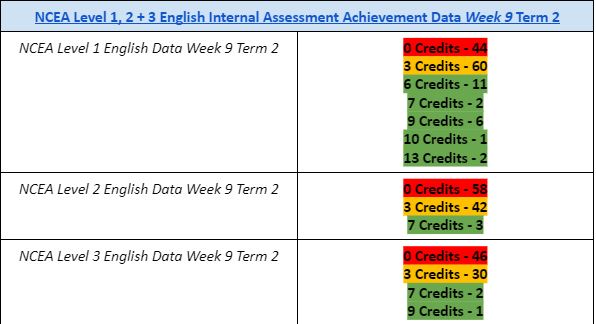
NCEA Level 1, 2 + 3 English Data Week 9 Term 2

It has been a challenge to try and get through our extended text study and assessment given the interruptions that we faced this term. But we are grateful for the shifts that we have seen with our student achievement data. We collectively agreed that we will continue to allow our students to work through any unfinished internal assessments in Term 3 as time in Term 2 has not allowed them to finish the work.

We understand and acknowledge that there are so many things going on with our senior students. Some are working, attendance is an issue and motivating students through this has become a challenge. In saying this, we are hopeful and determined to see it through with our students. We are going to continue working through the internal assessments as a focus for Term 3 as well as preparing our students for derived grade exams.

We look forward to working with our NCEA Level 1, 2 and 3 English students.


ENGLISH DEPARTMENT GOALS TERM 3


As a department, we like to discuss what our priorities and goals are. Sometimes our priorities change as we journey through the term but we try to stick to our goals as best as we can. Below are some of the goals that we would like to work towards in Term 2. 

  • Finish Internal Assessments - We want to prioritize Term 3 to helping our students finish their internal assessments for NCEA Level 1, 2 + 3 English. That means that for the majority of Term 3, our students will be working through starting and completing the final lot of internal assessments. We have all covered our text studies so we want to use the time to help our students get over the line. We will also make time in Week 6, 7 + 8 to go through Derived Grade Exam preparation.

  • Unit Plan + Design our Level 1 English Program 2024 - We have started to unpack the new NCEA Level 1 internal and external assessments. We have a draft plan on what we want the program to look like. We want to use time (hopefully during Hybrid Learning Day) to plan our units for the New NCEA Level 1 program. The collaboration and planning has already started and we have documented this in our English Department: NCEA 2024 Assessments folder. We hope to finalize our program by the end of Term 3.

  • Year 10 Literacy Assessment - The new literacy assessment will be assessed in Term 4. There are 17 - 21 students who have been selected from Year 10 to sit the trial assessment. We hope to work with these students during Hybrid Learning on Monday to teach them the literacy skills that they need for the assessment.

JUNIOR + SENIOR ENGLISH PROGRAM TERM 3


Junior English Program Term 3

The focus for our Junior English Program is our Visual Text Study (Film Study). We hope to complete the supporting CATS for the Visual Text Study - Close Viewing and Speech. We look forward to exploring visual language techniques with our students this term. 

Senior English Program Term 3

The focus for our Level 1, 2 and 3 students is to complete the internal assessments by the end of the term. We also want to make sure that our students are prepared for their derived grade exams which take place in Week 10. 

Term 3 is always a busy term and there is a lot of things that we need to complete with our senior students. I am confident in the team and I know that they are going to support our students in making sure that they cross the line. I am grateful for the team that I work alongside. All the best to all of my colleagues and students going into Term 3. 

Sunday, June 25, 2023

Week 10 Term 2 - Teacher Practice: Inquiry 2023: Create: Crafting a creative text (CAT Term 2) (June 26 - June 30)

The inquiry journey so far ... 

This term, I have been able to explore and establish some good stepping stones in my inquiry. From the reading groups (specific level reading groups), to the differentiated reading responses to the effective reading strategies - I have really enjoyed journeying through my inquiry with my focus class and teacher aide. I have particularly enjoyed documenting and blogging about some of the highlights throughout the term as it has helped me to reflect, review, appreciate the journey and evaluate what next steps that I want to take. Please see the blog posts that I have covered for my inquiry 2023 so far. 


The students have spent this term reading for learning in their reading groups and writing through specific frameworks tailored to their writing strengths. For the end of Term 2, my inquiry has taken myself and my akonga to CREATE - in particular creating and crafting a creative text. From Week 5 - Week 8, the students spent the time reading through the final short text (Witi Ihimaera's Big Brother Little Sister). From Week 8 - Week 10, the students are now crafting their own short text using the ideas and messages from Big Brother Little Sister. 
9TKl - Crafting their creative text


Creative Writing (Crafting the text) 

The Creative Writing assessment is part of the Common Assessment Tasks that they have to complete throughout the year. So far the students have completed the Formal Writing Assessment (Term 1) and this Term they will be completing Creative Writing and Create a Visual Text. The Creative Writing Assessment that I have offered to the students is inspired from the Creative Writing assessment that we offer our NCEA Level 1 students. A creative writing unit designed by one of the English Department members - Mr Spruyt - has become the springboard for my Year 9 inquiry creative writing task. 

Creative Writing Assessment Inquiry 2023

The creative writing task is broken up into 5 main areas, there are three main areas that they need to work through to help them craft their text. These areas are: 
  • Prompt - The students will go through different prompts for the creative writing to help students design an idea on what they can write on. 
  • My Chosen Image - The students are asked to go through a slideshow of images that are inspired from the text that they have read. The images reflect the different themes, symbols and messages.
  • Planning Space - The students will start planning their creative text. The planning place is scaffolded so that the students can organize each phase of their text. 

Prompt + My Chosen Image: 

Prompt/My Chosen Image presentation

The students were asked to go through the slideshow (on the assessment document) and choose ONE image that they will base their creative writing on. The images on the slide deck are linked to the imagery, themes, symbols and messages from the text Big Brother Little Sister. Prior to this, the students discussed the imagery, themes, symbols and messages through the effective reading strategies that we went through during the reading. Once they have chosen their image, they will move onto the planning space section. 

My inquiry class enjoyed this part of the assessment and they spent time discussing each image and how it is connected to the text. We did this as a whole class discussion and also in their reading groups. Students also have the option to choose their own image (if they find one that they like outside of the presentation). I had one student who chose their own image and checked it off with me. 

Planning Space: 

Creative Writing Planning Space Inquiry 2023

This step is crucial to the crafting of the text. In this section the students planned out who their characters are (based on the person/people in their chosen image), the setting (where the story takes place, the time in which the story takes place). Finally, the students were able to plan how each paragraph (3 in total) would look like. The three paragraphs are broken up into three sections: 
  • Paragraph 1: What is happening before the photo? - Here the student is asked to establish the setting, introduction of the character. Here the students can create a background story on who the character is, where they are placed and what has happened to them. 
  • Paragraph 2: What is happening in the photo? - The student is asked to describe what is happening the photo, describing the colour, mood, tone, character and explore the story. 
  • Paragraph 3: What is happening after the photo? - The student will create the last part of the text where they write about what has happened to the character after the photo. 
9TKl - crafting of the creative text (phase 1)
My students found this part fun because they were given full license to create and craft a story on their own. Some used the ideas and imagery from Big Brother Little Sister which is something that I expected. I encouraged my students to try and not to write to the text, but to come up with their own character and story line. Some decided to write a sequel to the text which I really liked. Once the students completed the planning space, they started to craft their text fully. 

9TKl: My student's response


The students responded really well to the assessment. We are in the final stages of the writing, there are four students who have already completed the writing. The students who have been really engaged with the creative writing and who have completed it are from the Level 2-3 Reading group. I believe that the scaffolding of the planning space and prior reading strategies that they went through in Week 5, helped them to understand what they need to do to craft a short text. The response has been positive and I am look forward to sharing about this in my Term 3 blog posts. 

9TKl - Crafting of the online book (phase 3)

The next phase of the assessment focuses on the students taking their writing and creating an online book. They will use the app - www.bookcreator.com - here they will create an online using the templates the app provides. They can create character images for the characters in their story. They full creative control on how their book is presented. I look forward to blogging about this once they students complete this final phase. 

Sunday, June 18, 2023

Week 9 Term 2 - Totara House: Journey | Destination - Looking back on Term 2 (June 19 - June 23)

The journey is all the little and big things that happened on your way to the destination. (Karthikk Pandit)  

Totara House Leadership Team @ Anzac Day - Term 2

Making time to reflect on your journey is important. The act of reflection can help you understand and appreciate what you have achieved whilst working towards your goal. Term 2 has been a very busy time for Totara House. At our last House Assembly, we spent time reflecting on the last 8 weeks and what we have achieved this term 2. It is very easy to get caught up in business of school, that you can often over look or miss the opportunities and blessings that you have gained along the way. The student leadership team and I felt that it was necessary that we used the time at our assembly to acknowledge what we have done, what has been done and show our gratitude especially to the students who contributed to the success. I also used this time to highlight the learning journey (something that I have always done in during our whanau time) in particular looking at the learning journey for our NCEA students. It is important to check in and look at the learning data with our students so that they are aware of where they are at so that they know what they need to do going forward. 


Celebrating our Identity, Language + Culture

'Knowing and understanding that the shared and ethnic-specific identities, languages and cultures of Pacific learners underpins the way they think and learn, which is fundamental to their well-being and success' (Tapasa 2019). Celebrating and acknowledging the different cultures, has become a highlight in the school calendar for Tamaki College. We celebrate this through different events throughout the year. In Term 1, we have Polyfest and in Term 2 we have two language weeks where all the students are encouraged to get involved and participate (Samoan Language Week and International Language Week). In Term 2, both the Samoan and International Language Weeks were placed together (Week 6 and Week 7). As the dean, I know that Term 2 is an exciting time for our house as we have opportunities to come together for the language weeks and work together as a team with the different events that each language week presents. 

For Samoan Language Week, we had two groups participate in the two main events (Siva Samoa House Dance Competition and the Volleyball Competition) both of which Totara won. For the International Language Week we had a number of students present their cultural story to the staff, play in the Soccer Competition, present a speech at a whole school assembly and perform a cultural dance at the assembly. We are really proud of the effort, time and commitment that each of the students from Totara House put into both language weeks. 

Totara House SLW Volleyball Team - Term 2
Totara House SLW Siva Samoan Group - Term 2

Totara House ILW Presentation - Term 2
Totara House ILW Soccer Team - Term 2

At our most recent House Assembly, the House leaders wanted to celebrate the journey and what was achieved in the journey this term. Specifically focusing on the language weeks as it was a important event in our house calendar. Totara House Prefect - Alo-Ki Hakau Hingano - acknowledged all of the students who participated in the Samoan Language Week competition. He said "Thank you to all of our Year 9, Year 10, Year 11, 12 and 13 students who all took part in Samoan Language Week. Learning about a new culture was fun because it made me appreciate my own culture as a Tongan." Fellow Totara House Prefect - Anika Crichton Ward - acknowledged the students who represented their culture for International Language Week. "thank you to all of our international students who represented not just our house but their culture for international language. Speaking in front of the whole school and performing a special cultural dance is a big thing, we are so grateful for what you did and for representing us well." Finally our Head Boy - Christian Kava - closed with a word of encouragement - "Thank you to Totara House for embracing new cultures and for respecting all of the new learnings that we have learnt this term. We have done things together as a House and we have represented our house and cultures well. Thank you on behalf of the leadership team for doing this with us." 


Reviewing our learning journey

Totara House NCEA Data Overview - Term 2

I went through the NCEA data overview at the House Assembly. This is an opportunity for the students to see their progress as a collective - to understand where they all sit as a cohort. I use this part of the presentation as springboard to talk to the students one-on-one about their individual NCEA learning journey. Term 2 is all about the numbers, making sure that the students meet credit protocol and so I know that it is vital that the data, the numbers, is shared with the students (both as a group and individually) so that they know where they are at. The focus was spent on what has been achieved and what the next steps and goals are. 

Gratitude is one of our House values for 2023. I believe that a spirit of thanksgiving, practicing gratitude and acknowledging it helps to shift our focus as a house. It is important to do this in your journey as it helps to give you perspective on what you have done, what you have been able to accomplish and not necessarily focus on what has not worked out. It allows you appreciate the journey whilst making your way to your destination. This was needed at this time of the term for my House. I wanted them to reflect and appreciate their story, in the hope that it will motivate them when they come back in Term 3. 

Sunday, June 11, 2023

Week 8 Term 2 - Teacher Practice: Inquiry 2023: Effective Reading Strategy 2 Week Intensive (June 12 - June 16)

In my inquiry reflection, the focus was on tailored writing exercises (response to text) for the 4 reading groups (see Alby's Blog Entry Post - 21/05/23). Since then, my inquiry journey has been focused on the final short text study (Witi Ihimaera's Big Brother Little Sister). It is an awesome story (appropriate for Year 9 English) that outlines the realities of Maori living in urban New Zealand. There are some dark moments in the text which highlights a dark reality that some families face. 

For this part of the inquiry, I wanted the students to spend two weeks deep diving into this text - reading the text, understanding the plot, characterization and the sequencing of events. Ultimately the study of the text and the comprehension activities would support the students in the crafting of their own text  - a creative writing assessment (something that I will blog about when we roll it out in the coming weeks!)

During the reading the text, my focus class had the privilege of having Mr. Milford (literacy expert) join in and support. This turned into a 2 week deep dive into the text (something that I did not plan for but totally welcomed). In the two weeks that we have covered the text, Mr. Milford initiated and shared some effective reading strategies that have 9TKl read for meaning and unpack the text through each phase of the story. The students have worked through the reading strategy in their reading groups. Marc has focused on the Level 4 - 5 Reading Groups (Pink and Yellow Group) whilst our Teacher Aide Viv and myself have worked with our Level 2 - 3 Reading Groups (Grey and Green Group). I will highlight two reading strategies that the students have been focused on this week and my take away for each. 


PRE READING STRATEGY

Pre Reading Strategy for Big Brother Little Sister

This strategy is an opportunity for students to increase their vocabulary bank. In this strategy, the students are given a list of words from the text and they are to sort the words into four categories - Setting, Characters, Plot and Tone Words. Once they have sorted through the words and placed them into the categories they then write a prediction on what they think the text is going to be about based on the activity. This helps the students to develop and build on their own general knowledge and to do their own thorough research and deep dive around the text before they read it. 


UNPACKING THE TEXT IN CHUNKS

Chunk Text Strategy for Big Brother Little Sister

The students read through the text once as a whole class. Once they did this, they worked through the text again in their reading groups. Mr. Milford broke the text into chunks, in their groups they read through chunks of the text and then completed a series of activities. One of the activities that they had to do was to highlight the key words from the excerpt. This helps to build their vocabulary and also it helps to reinforce the key characters, ideas and language that pertains to the text. The other activities would ask the student (after they have read the chunk) to list the events from most important to least important and then justify why they ordered it this way. Other activities would be a recount activity where they would have to write a one sentence summary of the chunk they have read - the summary must include the words that they have highlighted from the text. 

Grey Group

Pink Group

The student's response to this strategy has been positive. They like it because even though they are working in their groups, they can work at their own pace. Some students spend a lot of time through the text and highlighting the key words and then re-reading it to understand it. Others have enjoyed the short interval reading and completing the summaries as they are able to explain what they have read because it is done in smaller chunks. I would like to acknowledge Mr. Milford for sharing his expertise, time and strategies with 9TKl, it has been a valuable learning experience and one that we hope to continue on with for Term 3 and Term 4's text studies. 

I believe that these strategies have helped my learners not only deep dive into the text but read the text in a way that works for them. I have enjoyed the strategies that Marc has introduced because it has shown what I can do to better support my students in their reading journey. I look forward to taking the learnings from the reading strategy and use it to help the students craft their own creative story. 

Monday, June 5, 2023

Week 7 Term 2 - TOD: Manaiakalani Cluster Teacher Only Day (June 6 - June 9)

The Manaiakalani Cluster Teacher Only day took place at the end of Week 6 Term 2. The primary focus of the TOD was 'CREATE' specifically 'Creativity Empowers Learning' - For Manaiakalani Create/Hanga is built on engagement and empowerment. How are we harnessing Create to motivate our learners to ENGAGE with reading to learn and learning to read? Here is a break down on what we covered in our TOD: 

  • Session 1: Research + Data Analysis: We spent the first part of the TOD looking at the data for our akonga across the cluster (specifically Year 1 - Year 10) in writing, reading and math data. This was a deep dive presentation where we were able to analyze and reflect on our cluster and school achievement data. 
  • Session 2: Quality Learning Circles: In the second session, we broke off into smaller groups within our own schools (Quality Learning Circles) where we were able to share effective practice that meets one of the new literacy and communication curriculum progress steps. 
  • Session 3: Create Workshops: In the last session we went to different workshops that focused on how to harness creativity and how to use this to motivate our learners to engage with reading. 

Manaiakalani Cluster Teacher Only Day 02/06/23

In this post I am going to reflect on my take away from Session 2: Quality Learning Circles and Session 3: Create Workshop. 


Session 2: Quality Learning Circles

Quality Learning Circle session 2 (TOD 02/06/23)

The focus of this session was for kaiako to share effective practice that meets one of the new literacy and communication curriculum progress steps. The group that I was in was made up of my colleagues across the different learning areas. We looked specifically at our Year 11, 12 and 13 students in relation to literacy (reading and writing). We were able to share the strategies that we use and that we think we are effective for reading and writing in our learning area. I shared the literacy strategies that I have used with my Year 9 English class that links to my inquiry for 2023 (see Alby's Blog Post Entry - 02/04/23 - for what my inquiry focus is). It was awesome to hear the different strategies that my colleagues are using with their junior and senior classes, specifically what is working for them but also what challenges that are currently facing and the next steps that they want to take to address these challenges. 

Feedback from session 2 (TOD: 02/06/23)

There is good practice going on across the learning areas when it comes to effective practice of literacy. Some of the practice that we find to be effective with literacy (with reading and writing) is understanding the data and helping our akonga to understand their data. This is something that we want to do better in our teaching practice so that our students know where they are at and what their next steps to move onto the next level in their reading and writing journey. Teaching vocabulary specific to the subject area and exploring this language is another strategy that is effective specifically in Science, English and PE. Deep dive in certain words that are linked to a text study or to a topic can help build vocabulary banks for our students. Robust and positive feedback is an effective strategy that we all agreed on. Our students and in particular our senior students need and appreciate our feedback. I wrote a post on this (see Alby's Blog Post Entry - 15/03/22) on meaningful feedback and why it is important for our akonga. Setting high expectations is an effective strategy across all subject areas, believing that our students can and affirming the strengths that they bring to the classroom. I enjoyed this session as we were able to share and reflect on what we are doing but also learn from each other. I appreciated everyone's journey and the reality that we are working in. 


Session 3: Create Workshops

The focus for this session was to see how CREATE in our cluster is all about engagement and empowerment. The purpose of the Create worships is to see how we as kaiako can harness Create to motivate our learners to ENGAGE with reading. The workshop that I went to was 'Create with A.I' which was an introduction to a range of of AI options that could be used by akonga or kaiako to create as part of the learning process. I really enjoyed this workshop (led by Mrs Dorothy Burt), we were introduced to a range of AI options that we could use with our students to help encourage and engage them with reading. Some of the options that I really liked were: 

Click on the image to access the site: CRAIYON

CRAIYON: I really liked this AI option. It is an online AI image generator where you can type anything that you want and it will produce an image. What I like about this is that Craiyon is able to generate an image that is a result of what you type in the draw engine. It could be a good tool for students who like a visual component to their reading. They could type in descriptions of the setting or pull quotes from the text and it can help students visual the text that they are reading. If they are creating a visual text, this AI option can help bring the text that they have crafted to life. The advertisements on the landing page could be overwhelming but there is no sign in required so that is a plus. 

Click on the image to access the site: MUZIFY

MUZIFY: This AI option enables users to create a playlist for a text. You can type in the title of your studied text or chapter and Muzify will generate a playlist for the text. This is a great way for students to connect the studied text to other texts (something that we do across all year levels specifically in Level 1, 2 and 3 NCEA English). Also after reading the text, students can pull a character's name or an important quote and generate a playlist on this. It is relatively easy to use and does not require a sign in. 

I look forward to sharing this with the English Department and also hearing about the workshops that they attended! 

Week 9 Term 3 - Teacher Practice: Understanding Character - 91925 Character Essay (September 14 - September 18)

Character Profile  This essay plan is designed to help you dig deep into the characters of The Dark Horse. It kicks off by setting the stage...