Sunday, December 4, 2022

Week 8 Term 4 - Personal: Reflection 2023 (December 5 - December 9)

REFLECTION: serious thought or consideration

Over the last 5 years, I have prioritized reflecting on my teaching experiences through blogging. Initially I started blogging as I saw many of my colleagues doing it. Over the last 5 years I have enjoyed blogging as it is a way for me to reflect on what I am doing in class with my akonga and it has also been a way for me to reflect on what I am doing in my role as HOD of the English Department and as Dean for Totara House. A lot has happened over the last 5 years - with the COVID-19 Lockdowns to life after the lockdowns - blogging has been a way for me to unpack my thoughts and experiences and also document what has been helpful for me. 

This year I wanted to make sure that I prioritized blogging into my weekly routine, as a way to capture all of the things that I am involved with. I wanted to take this time to reflect and look back on 2022 and some of the highlights for me.


LEARNgain or acquire knowledge of or skill in (something) by study, experience, or being taught.


I have learnt so much this year both in my role as a teacher and in middle management. As a teacher, I have learnt that it is important to be open to change and that it is OK to not know everything. An example of this is through the integration of our literacy experts in our Year 9 and Year 10 literacy program. Taking the time to review what my current literacy practice is, what I need to improve on and what I would like to do in regards to literacy strategies was a positive but also daunting experience. Positive in that I was able to see what I am doing well but daunting in that I saw where I needed help. Teachers can be protective and their own gatekeepers in their classrooms and to have someone come into your space can be challenging. However I know that the at the heart of the matter of what we do as teachers, is the child, I had to be open to receiving help from the literacy experts if I wanted my students to learn and progress in their reading and writing. What I have learnt through this experience is that when I am open to collaboration with my colleagues, my students will then be open to collaboration. When I am open to change, my students will be open to change. What and how I model myself as a teacher will (hopefully) filter down to my akonga. The results have been positive with student engaging more with the writing and reading strategies offered by Mr Milford and Dr Jannie. I have seen my akonga's progress develop throughout the year and they have become more confident in their writing and their reading. It is a small but vital step going forward into 2023. 
Literacy expert Mr Milford and my Year 9 akonga 

CREATE: bring (something) into existence.

Creativity is defined as "the tendency to generate or recognize ideas, alternatives, or possibilities that may be useful in solving problems." As teachers, creativity is something that we working in everyday. Finding solutions to problems, how to motivate akonga, how to get to the finish line - we are finding ways on the 'what', 'when', 'who', 'why' and 'how' in all that we do. This year, I have found myself leaning in on those around me - whether it be my colleagues or akonga - when it has come to creating and creativity. There have been moments this year where I have found it challenging to create as I am trying to facilitate and manage my teaching and the teams I work with. As a result I have found myself in situations where I cannot offer anything in terms of creativity, so I delegated and leaned in on my teams to help bring things to life. An example of this is in my role as Dean for Totara House. In Term 3 we had Tongan Language Week and one of the big ticket items for this year's celebrations was the Inter House Tongan Dance Competition. In the weeks leading up to the competition we struggled to nail down what we wanted to do and there was a point where we almost withdrew from the competition as we did not have any options. The leaders and I have ended up approaching one of our Year 13 students to see if she wanted to create an item for the competition. She was very excited and open to the challenge and said yes. The process from here was effortless because she was excited to create and share something that she is passionate about - her culture - with the akonga. The Universtiy of Iowa states that "In an educational field, we talk about power sharing when students directly participate in an activity in which the teacher enables the students to share authority and responsibility and a just division of roles and accountability for their tasks." The result of this was that the students involved all were invested in the experience, they all felt like they had a part to play and they all felt like that had some type of ownership in this. Now my akonga in Totara House are keen to help with next year's celebrations because they have seen their own help and lead. Power-sharing has been the take away from me when it comes to 'create' and 'creativity' - when we create we can blur the lines - it is OK. That is the beauty of 'create' and 'creativity' - we can shift power to make something beautiful and meaningful. 
Year 13 Totara student Mounga Afemui teaching the lakalaka to Totara House for TLW

SHARE: a part or portion of a larger amount which is divided among a number of people, or to which a number of people contribute.


Sharing my learning and creativity through my blogging and then sharing this with my akonga has been a beautiful experience. I am grateful that I am able to do so. I am also grateful to share and journey with my colleagues. This year has presented many challenges but also has provided opportunities for collaboration. The mentorship team who I work with in Totara House have been an awesome team to work with this year. There have been a few moments this year where I have not been able to to be at school due to family reasons and the team have stepped in every time to share the load. I have tried my best to step everything up in way that whoever needs to lead, can because I have set the framework in place. The mentorship team for Totara House have been awesome in standing in the gap when I have been absent. I have always felt this need to be present all the time and to work through (even if I am unwell or do not have time to) but I have realized that there is a team there for a reason. To not just lead but to work with. This is something that I am grateful for this year. 
Some of the Totara House mentorship team 2023

Going in 2023 I hope to continue to learn and grow in my 'Learn, Create, Share' journey. I have ideas on what I would like to do better with these three pillars with both my students and the teams that I work with. This has been a great year and I look forward to the holiday coming up. Blessings. 

Sunday, November 27, 2022

Week 7 Term 4 - English Department: Mana Enhancing Writing (November 28 - December 2)

MANA ENHANCING: "Mana determines the right of a young person to have agency in their lives and the decisions that affect them. Enhancing the mana of young people means recognizing what is right with them, as well as the reality of their world. Young people are supported to have a voice, work to their strengths and step into leadership." (Arataiohi NZ - www.arataiohiorg.nz) 


As an English teacher, our job is to help our students draw and use their experiences when crafting their texts. A crafted text embodies all the key features such as ideas, structure, organization, spelling and punctuality. A well rounded crafted text must highlight these features but what can set it apart is the inclusion of the writer's own opinion, idea, perspective and experience. Making the connection between the idea in the text and the writer's perspective can help elevate the quality and the heart of the writing. 


As the term and year comes to a close, I have spent the last couple of weeks marking a whole heap of writing from Year 9, Year 12 (Level 2) and Year 13 (Level 3). My students have crafted some awesome texts and the ones that have stood out are the ones where the have used their voice, ideas and experiences in a way that is both meaningful to them as writers but also adds value to the text that they have crafted. Mana Enhancing Writing is what I see as an opportunity that students have taken in their writing, where they control and drive their own narrative. They feel comfortable and confident to express how they feel, show what they understand and write about it without any hesitation. I wanted to highlight some texts that my students have created and reflect on how I believe that this is Mana Enhancing Writing. 


Year 9 Writing Term 4

This student has crafted this text for his speech presentation. Their speech presentation is based on their korowai which they created online. The text is unequivocally their own, everything from the idea to the tone is based on their experience and identity. I believe that this is Mana Enhancing Writing because the student has used their identity as the driver in the how they have shaped the text. They have used what they see as their values and expressed what it means to them. This is the final task that I have given to my Year 9 students (speeches) and it has been a pleasure to see them write about what is important to them. I believe that the student felt comfortable in sharing their values in their text because it was modeled to them first. I reflected and wrote about my own korowai that I created and shared with my Year 9 students (see Alby's Blog Entry - 18/09/22). I believe that sharing my own experience and writing has helped give my Year 9 akonga the confidence to do the same. This was a Mana Enhancing experience for myself as a teacher. 


Year 12 (NCEA Level 2) Writing Term 3

This text is based on the NCEA Level 2 English internal assessment - 2.7: 91104: Significant Connections Across Texts. The premise of this assessment is that the student has to show significant connections across texts and explain what the connection. This student has chosen the theme of 'Hierarchy versus Authority' (a theme that we studied in class) and show how this theme is shown in four texts. For their fourth text - they wanted to talk about how the theme connects to their culture and their own family structure. I was all for this and encouraged them to explore this, as a text is anything that creates or holds meaning. I believe that this is an example of Mana Enhancing Writing because the student has taken the reality of their world and they have used it in a powerful and meaningful way in their writing. 


Year 13 (NCEA Level 3) Writing Term 4

This student has crafted a text based on a song that they have written and composed. The text is for their Writing Portfolio - where they have to craft two texts on any topic of their choice. Before the student crafted their text, they were stuck on what to do and write. I knew that they written and composed a song and thought that they could write about this. They were reluctant at first but I showed them an example of what I was asking them to do. I shared a reflection that I written on my blog about a song that I enjoy and have used as a text in class (see Alby's Blog Entry - 20/10/20) The student read it and understood what I wanted them to do. They used my blog as a guide and they crafted their text. I believe that this is a great example of Mana Enhancing writing because the student has used their reality, their identity and most importantly their strength - music, language and poetry - to craft a text that is meaningful and mana enhancing to them. We spend so much time unpacking texts written by others, trying to understand the author's purpose. It is beautiful and powerful to read a student unpack and explore their own words, their own narrative. 


Mana Enhancing Writing is something that I strive for, for my students. I believe that this has come about because I have had to share my own writing and experiences with my akonga. I believe that has become motivating for them as writers. It is a scary experience to share your writing with others, I have been reluctant in the past to share it. But I will continue to do this going forward as I believe that it is a good way to connect with my students. 

Sunday, November 20, 2022

Week 6 Term 4 - Totara House: Thanksgiving (November 21 - 25)

Totara House Assembly: Thanksgiving (04/11/22) 
In Week 3 of Term 4 (Friday November 4) Totara House held a special assembly. The purpose of the assembly was to celebrate the year 2022, reflect on what we have done together and to acknowledge our Totara House Student Leadership Team and our Year 13 students. The theme for our assembly was 'Thanksgiving' - a time for us to give thanks for this year and to reflect on our journey. Thanksgiving is a traditional holiday celebration in the United States of America where they celebrate the harvest and the blessings of the past year. The teachers of Totara (mentorship team) organized gift baskets for our student leaders and chocolates for our Year 13 students. Our 2023 Student Leadership Team helped me in hosting the assembly. I wanted to close the year off properly with Totara House as the rest of the term's focus is centered around finishing external and internal assessments. 

Totara House Assembly: Thanksgiving (04/11/22)
Family’, ‘Resilience’ and ‘Respect' are the Totara House values for 2022. Throughout this year, Totara House have done their best to exercise these values together as a family. Through coming together for the various House competitions and Language Week celebrations, Totara House have enjoyed their time as a whanau. I know that the students really enjoyed Tongan Language Week and Te Wiki o Te Reo Maori Language Week as highlighted in my previous post (Alby's Blog Entry - 24/10/22)

I am incredibly grateful to all of the Totara House Mentor Teachers (Mr Gutry, Mr Niko, Ms Paketama, Mr Koch, Ms Rani, Mrs Tuitupou, Ms Ferguson, Mr Booker, Mr Daniels, Mr Singh, Ms Kolo and Mr Milford) for their commitment to the house, their mentor classes and our values. I am forever grateful to work alongside a great team of mentor teachers!

I am especially grateful and humbled to have worked alongside an awesome student leadership for 2022. Miracle Heta, Siale Pulupaki, Lisia Pauu, David Betham, Maletina Niko, Lakai Vaisima and Falakika Tuakivakatau - thank you for your hearts of service and for your leadership. The way that the team have led Totara House through all of our House assemblies, rehearsals for language week performances, lunch time rubbish duties, meeting with the junior and senior students during mentoring times, taking our new students around the school and more - I am forever grateful. The influence that they have had over our House and the way that you have led with compassion, commitment and love is something that I will forever value, respect and miss. Thank you leadership team for leading with love and respect, I will definitely miss you all.

Totara House Student Leadership Team 2022

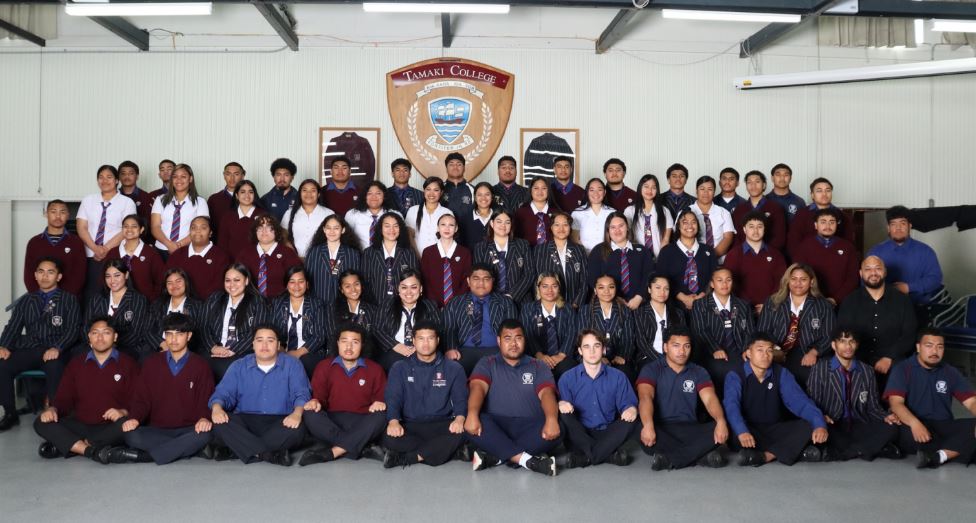
Totara House Student Leadership 2022 + 2023
As we close out 2022, I want to wish all of the Year 13 students (13TBk and 13TDs) in Totara House all the very best for the next step in their journey. The last 5 years have had its share of challenges, highs and lows. You have managed to navigate through NCEA Level 1, 2 and 3 in a time where many people would have given up. Thank you for what you have contributed to our school family over the last 5 years. Thank you for what you have given to Totara House this year. Thank you for your commitment to learning and to doing your best. Thank you for what you have given to our Totara family. I wish you nothing but the best for your future. 

Totara House 2022

Sunday, November 13, 2022

Week 5 Term 4 - English Department: TOD Hikoi + Unpacking New NCEA Standards Part 2 - 1.1 [91924] (November 14 - 18)

HIKOI: A hīkoi is a walk or march, and especially a protest march or parade, in New Zealand. The word comes from the Māori language, and often implies a long journey taking many days or weeks.

The NZ Curriculum states that "A local curriculum can enrich learning opportunities for ākonga and prepare them for lifelong learning by ensuring coherence and continuity of progress, both over the years and across settings." An important part of local curriculum is the integration of local stories and understanding the history and context of the space, community and area. As a school, we have spent the last 10 months exploring the concept of local curriculum and what it means and looks like for us. Understanding our local area and the stories of the people who own and belong to the land (Mana Whenua) was the focus for our most recent TOD. On Thursday November 10, the English Department visited five places of significance in the cultural landscape of Ngati Paoa. We visited Maungarei (Mount Wellington), Mokoia Pa (Panmure), Mauinaina Pa (Marist Rugby Club), Te Whanake (Pt England Reserve) and Waiorohe (Karaka Bay). Our school Matua, Matua Harley, led us on the hikoi and shared the stories of Ngati Paoa and why these places were significant to them. 


MAUNGAREI (Mount Wellington)

English Department @ Maungarei

What was significant about this place?

  • The name Maungarei means 'watchful mountain'
  • There are various kumara pits placed around the maunga
  • Shellfish (middens) was a rich source of food for the inhabitants of Maungarei. There are remnants of this within the mountain
  • A story connected the mountain is the story of the two sisters Reipei and Reitu. Reipae and Reitu were two sisters from Waikato who both fell in love with a chieftain called Ueoneone from the north. He and his people were hoping he would marry both sisters so he sent a large eagle down to collect them. But Reipei had second thoughts. "She wanted to alight from the bird and asked it to land at Whangarei. There she met another chieftain named Tahuhupotiki who she later married. Whangarei was named after Reipei. Reitu went on to marry Ueoneonei and Maungarei makes reference to her name. That was the connection between Waikato and the north. There are a lot of those sorts of love stories. Important values, such as preservation and protection of certain areas, can be communicated through these stories. 
  • How can use this in an English Literature context? We could use the story of Reipei + Reitu as a text for Year 9 + Year 10. Exploring the themes of preservation. 


Mokoia Pa (Panmure)

English Department @ Mokoia Pa (Panmure)

What is significant about this place?

  • Mokoia Pa was an area where Ngati Paora settled. 
  • In the 1820s the pa was attacked by a northern tribe and it was destroyed with many of those who lived there, who were killed. 
  • The river estuary was considered 'statehigh way 1' and played a key part in the new settlement's development. Right up to the mid 1900s, the Panmure wharf was used by cutters and scows to bring in supplies and to take away produce. 
  • Te Moko Ika A Hiku Waru was a taniwha, a water spirit, that guarded the mouth of the Tamaki inlet.
  • How can use this in an English Literature context? I could use the story or concept of the taniwha as a writing prompt for creative writing for Year 9, 10 or 11 English. It could also work for NCEA Level 1 create a visual text. The story of how the pa was attacked could be used a text for NCEA Level 2 or Level 3 English for Connections (2.4) or Connections (3.7). 

From here, our job is to see how we can take these stories, the places and the history and apply it to our learning area. I look forward to seeing how we can integrate the history of Ngati Paoa and the places of interest to them, and use it in a meaningful way in an English literature context. We are aware that we do not want to use it in a way that seems to be 'ticking a box' but in a way that empowers both akonga and kaiako to learn about the people and the land in which they live and ultimately reflect and appreciate our own culture, beliefs and values. 


Mauinaina Pa (Marist Rugby Club)

English Department @ Mauinaina pa

What is significant about this place?

  • The Mauinaina Pa belonged to Ngati Paoa, in 1821 Ngapuhi besieged the pa and hundreds of Ngati Paoa were killed. 
  • Excerpt from 'The Fall of Mokoia and Mauinaina and the death of Kaea. 1821' (Geo Graham) writes 'Te Hinaki was the chief of Mauinaina, he was armed with two guns; Hongi personally had six, he was also armed with a Kahu-mata (Coat of Mail) and a steel helmet. At the fall of the pa Te Hinaki lost his life, but he was really slain by a gun fired by a Ngati-paoa chief; this was his own people, and was the outcome of jealousy. Hongi found the body and decapitated it, taking the head to Ngapuhi.The seige of Mauniaina lasted three days, and when the pa was about to fall, Rewa of Ngapuhi sent word to those in the Mokoia pa on the river side to urge them to escape.'
  • First state housing (crown occupation) was at Mauinaina pa
  • How can I use this in an English literature context? Explore the the story of Te Hinaki and link it to another text (Divergent etc?) compare and contrast historical figures and the rise and fall of their reign. 

Te Whanake (Pt England Reserve)

English Department @ Te Whanake
What is the significant about this place?
  • Ngati Paoa are planning to build a marae at Pt England as part of their tribal strategy. 
  • I learnt here that the perspective and lens of Te Ao Maori is a view point that Ngati Paoa communicate. Te Ao Maori view encaptulates Maori values and culture. 
  • How can I use this in an English Literature context? Explore the idea of land ownership and what it means to live off the land and to live on the land. What does land ownership truly mean?

Waiorohe (Karaka Bay)

English Department @ the walk way to Waiorohe 

English Department @ Waiorohe (Karaka Bay)


What is significant about this place?
  • There is a plaque that commemorates the members of Ngati Paoa who signed Te Tiriti o Waitangi. 
  • How can I use this is an English context? Maybe look at the significance of names - history and do a research project on the history of student's names? This is a work in progress. 
The hikoi was a great experience. There was a lot of information to take in and to be honest, I am trying to filter through it all. I am inspired to use the stories from each significant place as a text in English and explore each text with my students, I may use my Year 9 and Year 10 English class as the focus group for these texts. 

UNPACKING 1.1 [91924]

In Week 5 of Term 3, the English Department started the journey in unpacking the new NCEA standards.  There are two internal assessments for the new Level 1 English curriculum and to date we have looked at one of the two internal assessments offered. We have looked at 1.2 [91925] and spent time unpacking the assessment. At the end of the session we had an understanding of what the standard is and what the opportunities are for us with the assessment. During our recent TOD, we looked at the standard 1.1 [91924] Demonstrate understanding of how context shapes verbal language use - we used the same approach to unpacking this assessment as we did with 1.2 in that we focused on six key areas as outlined below: 

What is the assessment?
What are the key words/concepts of the assessment?
What are the opportunities with this assessment?
What are the potential barriers for kaiako with this assessment?
What are our next steps?
Unpacking the three activities provided by NCEA

I will highlight what we discussed for each area: 

What is assessment?

Understanding the assessment - the fundamental elements of the assessment - is key. When we looked at the assessment our understanding of it was that kaiako have to focus on how language is shaped and used in different contexts. There are three ways that kaiako can present their findings. 
  • Written report (750-800 words)
  • Speech & slide show presentation
  • Oral presentation (just speech)
  • About an event - cultural event, formal occasion, interview

What are the key words/concepts of the assessment?

The key words and concepts from the assessment that stood out for us are: 
Context - it is a good word to understand. Emphasizes language as a ‘social thing’
Choice - multimodal - written, design and oral
Audience - knowing the context of the text helps you understand who the audience is
Verbal Language - Language Context
When looking at how language is shaped in texts (written + visual) we discussed that we need to focus on how PEOPLE use language not characters 

What are the opportunities with this assessment?

This is always an interesting and exciting area to look at. Once we had an understanding of the assessment, we started to see what the opportunities are for ourselves and our students. 
  • Novel study - interview with the author for the text studied
  • Film study - interview with the director for the text studied
  • Poem study - interview with the poet for the text studied
  • Marae - how is language used in a marae
  • Reality contexts - Language weeks, powhiri, Polyfest, online (twitter + tik tok)
  • Genre study - how is language used it genre studies
  • Summer Heights High/Bro Town - look at good/bad teaching practice - students to teach
  • How to/demonstration talk - presentation 

What are the potential barriers for kaiako with this assessment?

  • Cultural fluency - if we do zoom in on a Maori language text/context - how can we measure it, please everyone?
  • If there are classes struggling at a textual level - use a context approach that is concrete (like a job interview)  

What are our next steps?

Our next steps with not just this assessment but for the new standards is to Continue to talk and review the standard and changes with the team in readiness for 2024.

 
Everything that we discussed has been documented and we have already started to create an online folder of resources that we will use once the new NCEA Level 1 curriculum is given the green light. We know that there is time before this happens but we want to get our heads around the changes and to give ourselves time to discuss and understand the changes that are coming up. It is always good to be prepared and we are going to use the time that we have now, to prepare as a team for our kaiako. 

Sunday, November 6, 2022

Week 4 Term 4 - End of an era (November 7 - 11)

END OF AN ERA: When a period of time, which is marked by a significant event, comes to an end, we say it is the end of an era.


From 2018 to 2020 I had the privilege of being the Dean of 110 Year 9 students. It was both a challenging but also rewarding and fulfilling experience to lead and dean this year group. There are so many stories and memories that come to mind when I think of the Class of 2022.

When they first started college in February 2018, there were 88 students sitting in the auditorium. As the year went on your cohort grew to 121 students in total. Year 9 was their foundation year - a time where you tried to settle into school, learn a new routine and meet new people. It was a time period that I remember fondly, they were really compliant and obedient in Year 9. 9KRo, 9KSw, 9PSd, 9RMz, 9TGn and 9TTu - I remember these classes and all of the different moments (both good and bad) that you all went through. I remember how eager and excited they were for the Year 9 STARS Camp, the talent quest (won by 9RMz), helping the elderly at the church across the road, playing badminton with the Asian community for your community project - the list goes on! 2018 was an awesome start for you as a group. They got involved with the school activities and were present in almost all of the school events. We finished 2018 with the whole year group going to Rainbows End, Parakai Pools and the movies as a reward for their good behavior and for finishing their first year at college.

2019 was their promotion to Year 10. They started to test the boundaries (and my patience especially with the boys playing Man Hunt!) I watched the now Year 10 cohort navigate high school and all of the challenges that came along with it. It was a time where personalities, relationships and the dynamic amongst the year group shifted. I remember the numerous pastoral meetings and parent meetings that I had with the students and their families. It was challenging as I spent a lot of my time following up with the students. However I knew that it was important to invest the time into the pastoral care, it was and still is an important of a student's journey at college. For some of the students in Year 10, 2019 was a year where they were offered opportunities to lead. Attending leadership camps to upskill their leadership potential - this was highlight for me as their dean. They finished their junior college years by participating in the NCEA Level 1 Jump Start Program and completing the High Ropes Course. This was your first taste with NCEA and you all took the opportunity to start banking credits in Year 10. A highlight for me was seeing them all take part in the High Ropes Course and to finish with 97% of the cohort achieving 3 Level 2 credits (US). I saw them start to take their learning seriously and I knew that they were eager to start your NCEA journey.

2020 was our final year together as a whole year group. By the end of Term 3, 56% of our year group had already passed NCEA Level 1. Despite the extended lockdown and interruptions to the school routine, they managed to rise above it and achieve NCEA Level 1. 2020 was one of my favorite years with the year group. The novelty around online learning was new and the response from the students was positive. They were invested in their NCEA journey and regardless of where the learning took place, they were very keen to pass NCEA Level 1 Despite all the interruptions with COVID I was and still am incredibly proud of what they were able to achieve as a collective in 2020. By the end of 2020 85% of the cohort had passed NCEA Level 1.

I knew that there was something special about this group when I first met them all in 2018. Although we were not able to finish high school together, I am still grateful for the time that we had together. They have given me a renewed sense of purpose as a teacher and as a dean. I know that I poured a lot of heart into leading this group throughout 2018, 2019 and 2020. It was an absolute privilege to have spent those years with them. Now at the end of their college years, it is truly the end of an era. An era where I have grown through all the challenges and tests that I faced as their Dean. An era where I have used my testimony and story to help guide the students through their own journey. An era where I have used every opportunity especially the assembly session, to speak life to the students. An era where I have learnt so much from the students especially during 2020 - a time where everything was interrupted.

Thank you to the Class of 2022 for bringing so much laughter, headache and joy into my life. Thank you to the Class of 2022 for helping me keep my ‘faith’ alive. Thank you to the Class of 2022 for your patience, your understanding and your resilience during your time at college. Thank you to the Class of 2022 for your loyalty, for your heart and for your trust in me over the years. I pray that GOD will continue to fulfill every hope and dream that you have. I pray that GOD will cover you and your families. I pray that you continue to seek excellence, because you are excellent. Whatever you decide to do, whether it is pursuing tertiary studies or work, please do it with all of your heart. Your heart, your character and your values are your greatest assets.

From the bottom of my heart, thank you Class of 2022. 

Class of 2022

Year 9 memories 2018

Year 10 and Year 11 memories 2019 - 2020

Monday, October 31, 2022

Week 3 Term 4 - English Department: Rebranding online presence (October 31 - November 4)

 Earlier this year I met with our Manaiakalani Online Support (Mr Goodwin) and we went through my Google sites. It was discussed that the Google sites, although good, needed an updated and he asked me to consider using Work Space. I am one of those teachers, who started with online learning in 2011 and since then I have invested a lot of time and resource into creating my Google sites. Google sites is something that I (along with many other teachers) have become comfortable with and it is something that I can navigate through quite easily. In 2020 I went through a complete revamp of my Google sites, making it user friendly for my classes. Currently I am operating three Google sites - one junior English Google site and two senior English Google sites. Between 2016 - 2019 I spent three years going between my Google sites (from the old server) and sharing documents from my drive. It was not until 2020 that I decided to revamp my Google sites and I began using the new Google site template. 

Year 9 English with Stevenson (click on the image to access the site)
Level 2 English with Stevenson (click on the image to access the site)

Level 3 English with Stevenson (click on the image to access the site)

Year 9 English with Stevenson is a Google site that I created for my Year 9 English students in 2020. I also created new Year 12 and Year 13 English sites in 2020. I used the time during the lockdown in March to revamp and rebrand my sites as we were moving into online learning. This was an opportunity for me to do a complete overhaul with my Google sites and create something new, relevant and accessible for my then students (in 2020). Like most teachers, I love creating my Google sites as I have complete creative control and I can tailor it how I want it to look. My students used the sites to access the learning and assessments. My class calendars were all embedded onto my sites and made sure that every page, document and link was open to all as my student's parents were checking into the sites and online learning during the lockdown. It has now been three year since I did the overhaul and I have noticed that the Google sites is more of 'grab your resource' hub for my students and the engagement that I am hoping for - using my site as a learning tool - is not happening. 

Workspace is an online app that was introduced a few years ago and it is something that the students really enjoy working from. It is simple and user friendly app that teachers and students use to do a unit or units of work. I was a little reluctant to use it as I was (still am to a degree) avid Google site user. I have learnt that Workspace is something that the students prefer and Google sites, is something that most teachers that I know are comfortable with. Google sites, in an online learning world, is still a good platform to use but it is something that appeals to our parents so that they can see what their child is doing. Workspace is a platform that is easier and more efficient for our students. 

New google site for 2023 - English with Mr Tu'uga Stevenson

During the Term 3 holidays, I created a new Google site. My new site features all the learning levels (Year 9, Year 10, Year 11, Year 12 and Year 13). I have also created workspaces for all of the Common Assessment Tasks in our Junior English Program (4 CATS in Year 9 and 6 CATS in Year 10), as well as workspaces for all of the internal assessments that we offer to our NCEA Level 1, 2 and 3 English students. Mr Goodwin shared a template Google site with me before the holidays and I was taken back by the basic outline. I am the type of person who likes to format and add links left, right and center. The new Google site template is a lot more simple but it has what the learner needs - access to the calendar and embedding the workspace from the site. The site, again, is a reference point for the students so that they know that there is a space for our learning. The most important thing is that they have Workspace available to them. The site, is the focus point for the parent or caregiver - a place where they can tap into their child's learning. Although they cannot access the workspace, they can still see what their child is doing. 

I have shared this with my team with the hope that they too will revamp and rebrand their online platform. I have made a copy of my site and taken away anything that is related to me - making a generic English site (with all the links to the new workspaces embedded). I have done this so that my team do not have to start from scratch and if they want to, make a copy of the new site and add their own spin to. Or they can embed the workspaces into their current sites. 

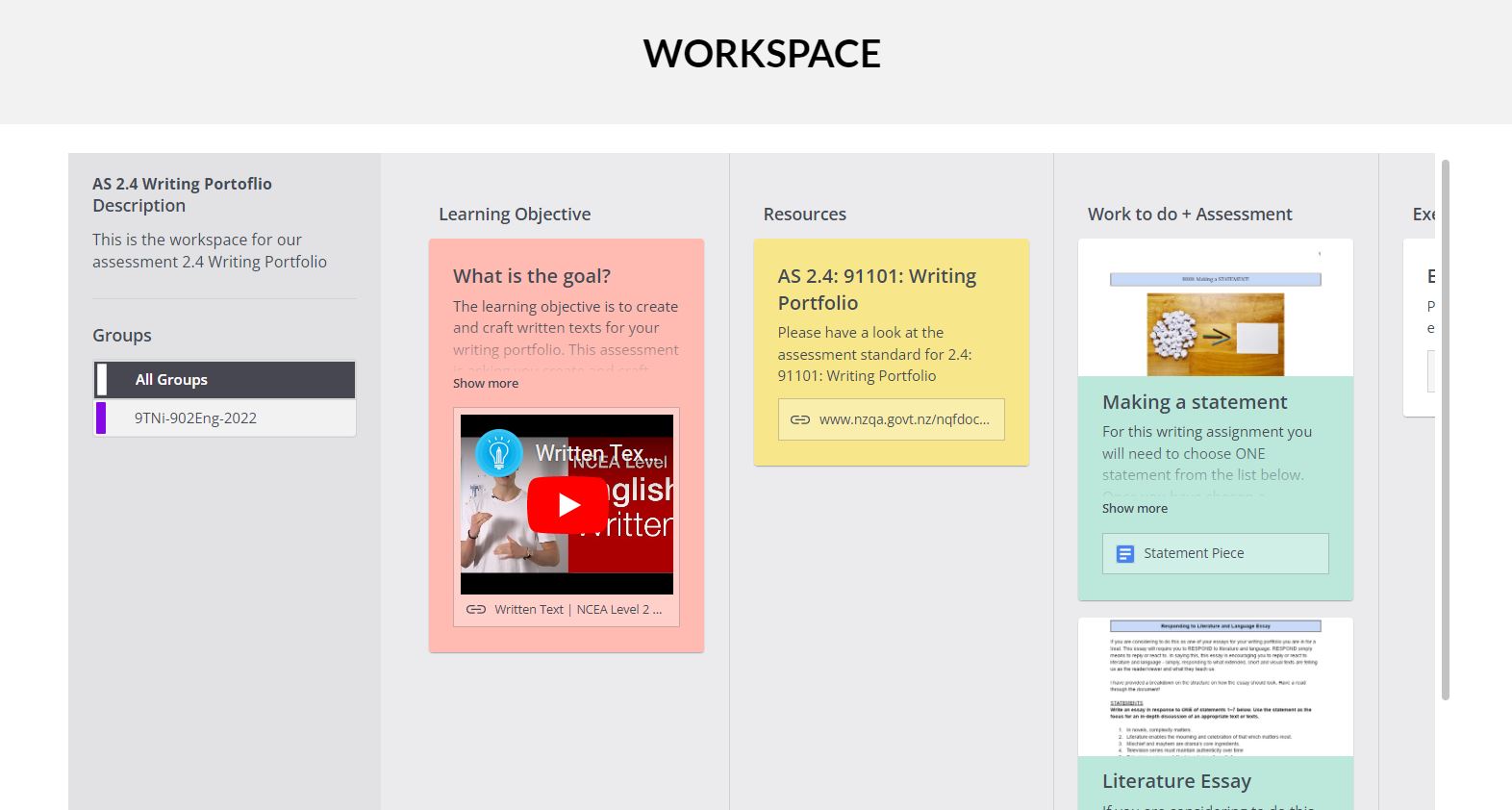
An example of the workspace that I have embedded onto my site.

Why did I do this? The truth is that I did not want to, I was comfortable with what I had in place. Mr Goodwin showed me the possibilities that workspace has for our students and I also saw how other members in my department were using it in their learning spaces. I wanted to change my approach to online learning going into 2023. I wanted my online learning to be engaging and interesting for my learners and I wanted to grow with them online. I am not going to completely abandon by old sites, I have made links to my current Google sites as reference points for my senior students as I still have some exemplars and resources there that they can use. 

Rebranding our online presence as a learning area (English Department) is something that has been on my priority list since Term 2. We all have our own sites that represent who we are as teachers. I love this part of creating sites and learning spaces online, you can create a learning space that is tailored to your students and to your strengths. I think that with engagement changing with sites and now onto Workspace, I would like to see the department adjust their sites to what the students respond well too. As online and hybrid learning continue to shape how we teach throughout the year, I believe that it is important to adjust and change with it so that we can keep things relevant for our students. 

Our online presence is only part of the package now. How we teach, interact and relate when we are face to face is important and valid. I know that rebranding how we present and share the learning online is going to be a journey - it took me a while. But I am willing to go through this individually with each department member and walk them through it. 

Monday, October 24, 2022

Week 2 Term 4 -Totara House: Review of Term 3 + Plan for Term 4 (October 25 - 28)

Term 3 Overview

Term 3 was another full on, challenging, exciting and rewarding 10 weeks for Totara House. Our main goals for Term 3 was to: 

  • Maintain our standard for our House Assemblies - we wanted to ensure that we set the tone and expectation at our House Assemblies for Term 3. We meet every Friday with the House (mentor teachers and students) - this time that we have together is important and we wanted to make sure that we were always prepared and ready for our assemblies. 
  • Get involved - The Term 3 calendar is packed - from Derived Grade Exams (for our senior students), to Tongan Language Week, Te Wiki o Te Reo Maori Language Week, Sports etc. We wanted to make that Totara House was represented in every school wide activity and event. 
  • Explore our House values - Our House values are Family, Respect and Resilience. We wanted to explore these values (during our House Assemblies) and also through the different school activities. I wanted the students experience these values in meaningful and exciting ways. 
Totara House Assembly Term 3
We were excited to meet our goals in Term 3 and none of this would have been possible if it was not for the people. A popular Maori proverb 'he waka eke noa' which loosely translates into 'we are all in this together' is something that I believe Totara House collectively pursued in Term 3. From our House meetings, to the various school events to the everyday things that we dealt with at school - it was a collective effort from everyone in the House. I am incredibly grateful to the mentorship team (Mr Gutry, Mr Niko, Ms Paketama, Mrs Rani, Mrs Tuitupou, Mr Koch, Ms Ferguson, Mr Booker, Mr Daniels, Mr Singh, Mr Milford and Ms Kolo) for their commitment and leadership to all of the students in Totara House. The Student Leadership team (Siale Pulupaki, Miracle Heta, Lisia Pauu, Maletina Niko, David Betham, Falakika Tuakivakatau and Lakai Vaisima) for their energy and commitment in how they led all of the students in every event during Term 3, I am humbled and very thankful for what they brought to the table. Finally, all of the students in Totara House, I am grateful for and for what they all contributed to the House in Term 3. 

I want to reflect on some of the highlights for Totara House in Term 3.  


Tongan Language Week 2022 (Term 3 - Week 6)

Tongan Language Week took place in Week 6 of Term 3. Different events were organized that involved students taking part in whether it was for online quizzes, to singing Tongan songs, playing Tongan games and participating in a whole house Tongan dance. The student leadership team decided that they wanted to get as many students involved in all of the activities. Prior to TLW, the student leaders were strategic in how they got the students involved. During the House assemblies leading up to TLW, the student leaders spoke about the event and encouraged the students to get involved. They also wanted to make sure that they were across the event, that they were fronting it so that they students could see it and follow through. A highlight from Tongan Language Week was students performing the Lakalaka for the Inter House Tongan Dance Competition. Initially we were going to do a Ta'olunga as we were not sure if any students wanted to perform. We prepared for a Ta'olunga which is performed by a small group of females. However we discovered that both our boys and girls wanted to take part - so we decided to do the Lakalaka (group dance). One of our Year 13 students offered to choreograph the item and teach both sets for the girls and boys. Rehearsals took place at lunchtime and afterschool. The students committed to all of the rehearsals and through this, worked together as a family (one of our House values). The students were really excited to perform and were even more excited to have perform in front of their friends and families at the competition. They placed first and were over the moon! 

Totara House Tongan Language Week 2022 Term 3


Te Wiki o Te Reo Maori Language Week 2022 (Week 8 - Term 3) 


Te Wiki o Te Reo Maori Language Week took place in Week 8 of Term 3. This week was highlight not just for our House but for all the other Houses. The students spent the week preparing, learning and rehearsing the Tamaki College School Haka - to share and perform at the Inter House Haka Competition. We thoroughly enjoyed the preparation in learning the haka as it was something special and personal to us. Our Totara House Captain, Siale Pulupaki led the charge for Te Wiki o Te Reo Maori Language week and spent lunchtime and after school preparing the students for the haka. Our House values of family and respect come to mind when I think of Te Wiki o Te Reo Maori Language Week. Many of the students who participated in this event were not Maori and so we spent time throughout the week talking about the significance and beauty of the haka and how it is our job to learn, honor and respect this tradition. Coming together, as a team and family, to learn something new helped to enforce the value of family - again, the students enjoy working together and this is something that we really enjoyed in Term 3. The students placed 2nd overall - but placings aside, they were excited to come together and really perform with heart and passion. 

Totara House Te Wiki o Te Reo Maori Language Week 2022 Term 3

Plan for Term 4


The plan for this term is to FINISH WELL and FINISH STRONG. For our Junior and Senior students, the focus is to finish the academic year well - completing internal assessments and preparing for the external assessments (which will take place in Week 5). We will be having our final House assembly at the end of Week 3 and I look forward to honoring our Student Leaders and Year 13 students. I hope to use our final assembly to celebrate and acknowledge our Year 13 students as this is the final term before they finish college. I also look forward to honoring and celebrating our Year 12 students - in particular those who have earned leadership roles for Totara House 2023. We have had an awesome year so far, but as I say - it is not how you start but how you finish that is important. So I am hoping for a strong finish for our House - a finish where we are able to close the loop on everything that we need to do for our learning. 

Week 1 Term 3 - English Department: Term 2 Review (July 20 - July 24)

As Term 2 has ended I find myself reflecting on what has been a remarkably busy and long journey. It has been a term defined by its challeng...