Sunday, March 3, 2024

Week 6 Term 1 - Teacher Practice: Reading Journey for Year 9 English: Embracing their literacy + Reading Groups (March 4 - March 8)

EMBRACING THEIR LITERACY 

In my last post (see Alby's Blog Post Entry - 25/02/24) I reflected on 'understanding your literacy' - in relation to my Year 9 English class understanding their PAT reading comprehension results. Since then we have spent time in Week 4 and Week 5 understanding their literacy journey and what it looks like in relation to their PAT reading comprehension levels. 

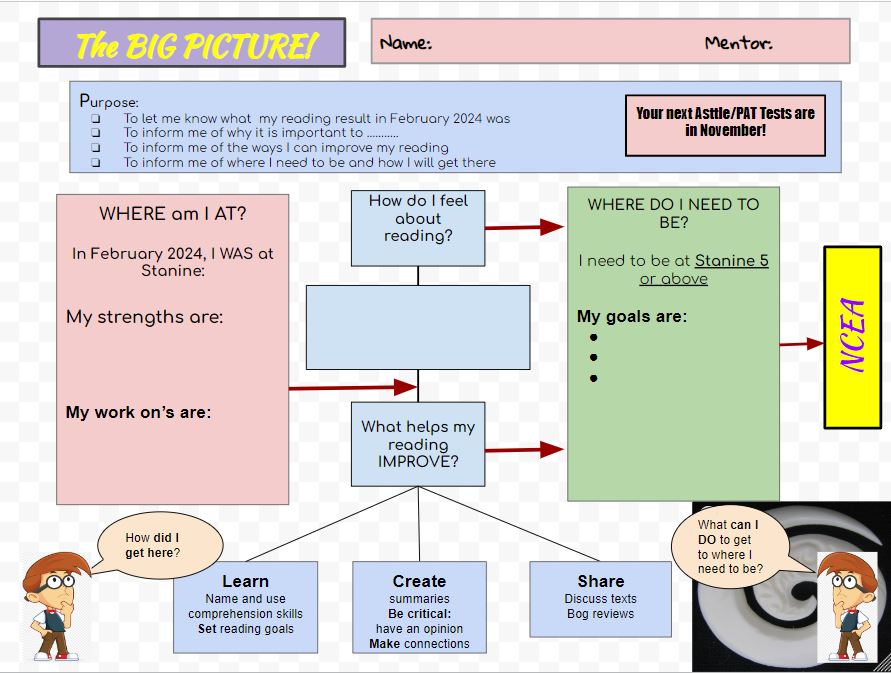
We have spent time understanding the curriculum levels and where student are expected to be with reading. I have also used the time to affirm the students, that their PAT reading comprehension results (and/or number) does not define who they are as a person, it is an indication for the teacher to see what areas need support and how they can help them grow in reading. The student's have used the 'Big Picture: PAT Reflection Document' to review their reading score and to set some goals for reading. 

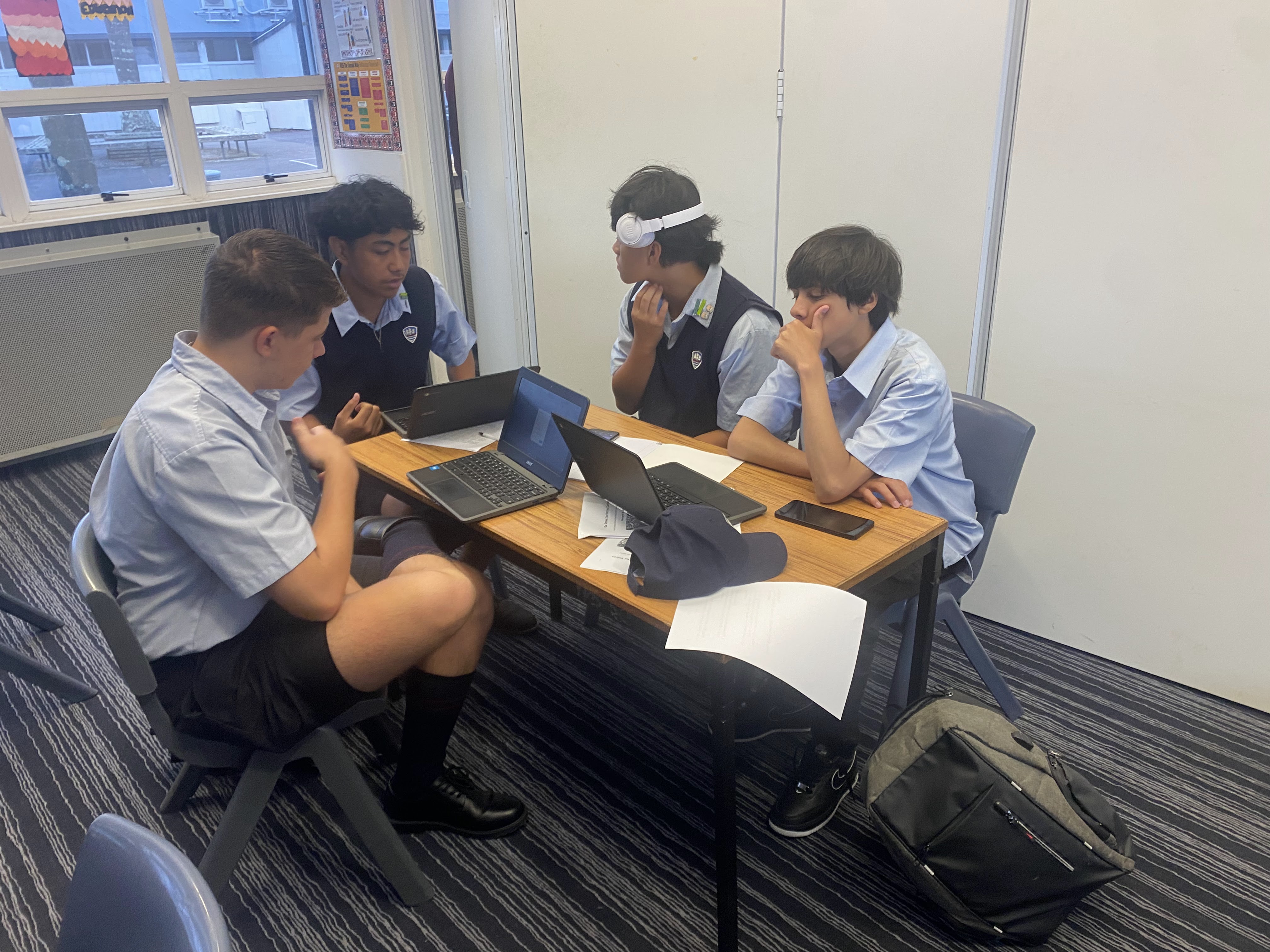
Y9 with their PAT Reflections 

Embracing their literacy is an important part of their learning journey. My intention for the students is to embrace their literacy - accept it and own it regardless of where they are in their curriculum level. Some of the feedback that the students have shared with me in relation to embracing their literacy is: 

"I am not really happy with it because it is not a recommended level I am suppose to be at. When I see my reading level now, it makes me want to work harder" 

"I feel OK about it. I want to bring it up (my reading) because it's going to help me when I get older"

"It's OK, I am at the right level. I want to make it better to get a higher mark"

"I was very happy because I got higher than where I am supposed to be. I want to get Level 8 next time" 

Overall they appreciated knowing where they are with their reading levels and are aware that there is room to improve and grow. Knowing this going into our new reading unit is going to be really helpful for both myself and my students. 

READING GROUPS

For our new reading unit, the students will be working through it in reading groups. The groups are determined and designed based on their reading scores from our most recent PAT reading comprehension test. 

PAT reading comprehension results (Term 1) for my Y9 English class
Across the class, there is representation across Curriculum Level 1, 2, 3, 4, 5, 6 and 7. I have organized the groups into four colors: 
  • Yellow Group: Stanine 1 - Stanine 2
  • Blue Group: Stanine 3
  • Green Group: Stanine 4
  • Purple Group - Stanine 6 - Stanine 7

As we approach our new reading unit, the students will work in these groups for the reading comprehension. The students will read the same text but I will design different comprehension tasks for the four different groups that builds on their strengths and hopefully strengthens their areas for improvement. My intention with the reading groups is to keep the students in these groups for the remainder for Term 1 and then mix them up in Term 2. Keeping them in their reading level groups will help me manage the comprehension tasks, the students can work together in silo and hopefully improve. When I mix the groups up, they should be able to bring their strengths and work together. I look forward to documenting the journey! 

Sunday, February 25, 2024

Week 5 Term 1 - Teacher Practice: Reading Journey for Year 9 English: Understanding your literacy (February 26 - March 1)

It is that time of the year where the annual AsTTLe and PAT Reading tests take place. These tests are an opportunity for both student and teachers to understand where they are in their literacy (reading and writing) journey, what areas of opportunity there is to improve on and what their strengths are. We have just recently completed our PAT Reading Comprehension Test with our Year 9 students. Before we launch into our first text study for the year, I wanted to start this unit of learning with their PAT reading results. I wanted to use this as an opportunity to work with the students in helping them: 

Understand their data

What it means to them

What it means to me as their teacher

How we can work together

What I have done with my students so far in this part of the unit is looking at the data and unpacking the data. As they are in Year 9, I have tried to keep the languaging relevant and 'light' to them. We looked at the overall picture for PAT stanine reading levels. 

Looking at the PAT Stanine Reading Levels
It is important to explain the data to students so that they understand what it is and how it applies to them. I made it clear that the curriculum levels are there to help teachers, students and families understand where they're positioned in terms of the curriculum level. I then shared the student's PAT reading levels (February) and went through it with them one on one going through: 
  • Sharing their data: The reading level that they achieved from the PAT Reading Comprehension test

  • Identifying their strengths: Identifying their strengths that they already have in their reading comprehension is the next part of the conversation. We have just started this discussion and it is interesting as my students (those in Level 2 to those in Level 6) do understand what the strengths they carry in their literacy. So we have started to talk about what they can do with reading, what they find easy, what they enjoy - affirming and identifying it as a strength. 

  • Areas to improve on: When we start this part, I am going to get the students to identify 3 areas they think they need to improve when it comes to reading - I will scaffold it and give them some options to consider (achievable goals that can either do in their own time or at school). It could be - Discover your reader identity - find out what you type of texts you like to read and spend X amount of time during week reading these texts. Vocabulary - Building work banks linked to the texts and spending time to explore to these specific words to the text to help them understand the text. 

  • Goals: I hope to get the students to the point where they can some reading goals for Term 1. I am hoping to do this by the end of Week 6 Term 1. Increasing reading fluency and a healthy and safe reading culture in the classroom is one thing that I want to create in my class for my Y9 students this year. 

A colleague has created a post PAT reflection worksheet for students to work through so that they can reflect on their literacy journey and work through the next steps and actions. I really liked it and I have started to use it this following my conversation covering the four parts I have outlined above. 

The Big Picture! Post PAT Reflection Document
Next Steps: 

  • I am hoping to get through 'The Big Picture' in our next class (Tuesday Week 5)
  • From here I will create a check in point to see where they are at with their reading goals. 
  • Once the students have completed on this, I am going to put them in reading groups. The students will read through the same text but their reading comprehension questions will be customized according to their group (reading level groups). They will stay in their reading groups for Term 1 and then I will mix them up in Term 2. 

Sunday, February 18, 2024

Week 4 Term 1 - Teacher Practice: Summative Assessment 1.3 (February 19 - February 23)

OUR STORIES, OUR HISTORIES, OUR VOICES

The new curriculum refresh for NCEA Level 1 English has officially launched at Tamaki College. Our focus and theme for this year is 'Our Stories, Our Histories, Our Voices'. The theme is centered around the concept of 'our stories', 'our histories' and 'our voices' as something that we need to treasure, acknowledge, explore and celebrate. After all of the planning and drafting of our new NCEA Level 1 English course, we are excited to start our year off with the new curriculum refresh. 

The primary focus for Term 1 is 'Our Stories and Our Histories (Through Film)' with the primary text being the film 'The Dark Horse' (Napier 2014) and the assessment to flow on the text study being 1.2 - Demonstrate understanding of specific aspects of studied texts. For my Level 1 class, the plan is to start the film study of 'The Dark Horse' (watching the film and studying the film - scene analysis, character analysis and film techniques) in Week 3 to Week 7 of Term 1. 

SUMMATIVE ASSESSMENT: Summative assessment is intended to summarise student achievement at a particular time, whereas formative assessment is intended to promote further improvement of student attainment (Crooks, 2001). However, summative assessment can also be used formatively, if it provides feedback to the student, teacher (TKI)


Prior to the film study, I prioritized space and time for my students to complete a summative assessment. The summative assessment I put in place is aligned with the external assessment that the NCEA Level 1 students are going to do in Term 3. This assessment is 1.3 - Develop ideas in writing using stylistic and written conventions. For this external assessment, the students have to craft a text that is centered around a statement of intent. The text that they craft needs to be in a style that they choose from persuasive writing to formal writing or creative writing - the students must use the correct stylistic and written conventions for the style of writing that they choose to craft their text. In order for the students to understand what style they want to write, I knew that I have to provide opportunities for the students to try different styles of writing so that they know what they are going to do come Term 3.
101ENGE doing their summative assessment for 1.3
I am going to outline the summative assessment and what I did with my student's in Week 2 of Term 1 and explain my learning from this experience. 

Phase 1: Our Stories | Our Histories

Integrating local curriculum into the summative assessment

An integral part of 'Our Stories, Our Histories, Our Voices' is celebrating 'our stories' in the classroom. We have had the privilege of learning the history of our local area and in particular our iwi - Ngati Paoa. For the summative assessment I used one of the stories from our iwi and the history behind the name 'Maungarei'. We read this text and the discussion around how history, tradition and customs for Maori and Polynesian families is transferred through conversation, through song, through oratory practices. It was a great discussion following the reading of the text. 

Phase 2: Crafting a Persuasive text

Summative Assessment: Persuasive writing task
The students were given the task to craft a persuasive text using the prompts above. The word limit was 500 words and the students had to decided what their argument is, write a statement of intent and find evidence to support their statement. The students spent two sessions crafting their text. 
Student Exemplar from 101ENGE class

Phase 3: Peer feedback

101ENGE Persuasive Writing Feedback

The students spent the last session reading their persuasive texts to each other in small groups. Once they shared their text, we had a whole class discussion where the students shared their feedback to the whole class. The feedback was framed by three questions (below):  
  • What did you like about their text and why?
  • What was their opinion/argument?
  • What sentence starter/prompt did they use well? Give an example. 
Feedback session for 1.3 summative assessment

Some the feedback from the student's: 

"I really enjoyed their piece. Their opinion really made me think about my own and where I stand with it."  
"He had researched online and used it to back his point, I like that and I felt that is something that I can do to support what I like."
"I liked how they used the prompt - I disagree - because it was strong and it showed me where their argument is at straight away, no mucking around."
"The sentence starter that she used well was - I believe - she used it throughout the piece so she kept repeating it which made me see her point."

This was a fun part of the summative assessment. The students were able to see what their friends wrote and learn from it. Sometimes we learn the most through the eyes of those closest to us, I felt that this was a meaningful and beautiful way to end our summative assessment. 

Next Steps: 

  • I want to do another summative assessment with the film that we are studied in Week 3 - as the primary text. I will do another persuasive writing summative assessment so that they can give it another go! 

Sunday, February 11, 2024

Week 3 Term 1 - Teacher Practice: Inquiry Framework for NCEA English Data (February 12 - February 16)

Investigating and unpacking data is an important part of our teaching practice. More recently in the last 5 year I have taken a deep dive into this space where I am unpacking the achievement for NCEA English and it is a space that I am still learning and growing into. At the beginning of the year the NCEA English results were released for our NCEA Level 1, 2 and 3 English students. Initially I was surprised by the results and I found myself logging in and out of the NZQA a few times to make sure that what I was seeing was not just my imagination. 

Overview of NCEA Level 1 + 2 English Results

My first response to the results was shock and disappointment. Across each year level the (Level 1, Level 2 and Level 3 English) our students did not perform well in their English exam. 
Overview of Internal Assessment Results for NCEA Level 1, 2 + 3 ENG
Our internal assessments results were on track and I am really happy with how these results worked out. Overall we had a number of endorsements across NCEA Level 1, 2 and 3 English that we are really proud of. They are as follows: 

  • NCEA Level 1 English Endorsement: 34 Achieved Endorsement + 2 Merit Endorsement
  • NCEA Level 2 English Endorsement: 12 Achieved Endorsement + 6 Merit Endorsement
  • NCEA Level 3 English Endorsement: 3 Achieved + 1 Merit


INQUIRY: noun,plural in·quir·ies. a seeking or request for truth, information, or knowledge. an investigation

Now that I have had some time to reflect on the results, I have decided to launch into a mini inquiry for Term 1 focusing on the achievement data for our NCEA Level 1, 2 and 3 English students (2023). For my inquiry I have used a framework that enables me to identify all the key drivers to the successes and the failures for our NCEA English results. From here it is all about finding the solutions to the gaps and organizing the next steps to action the solution. I have found that this type of inquiry framework useful so that I can keep myself accountable and also track the progress (or lack thereof). 
My Inquiry Framework - Term 1 


  • Identifying our key drivers (reasons for achievement and non achievement)

English Department @ Careers Expo 2023
I have already started to identify the key drivers for the successes and failures for our NCEA English results. I believe that our successes are connected and rooted in the following drivers: 
  1. Good Relationships - Good relationships with the students, where the student's understand the expectation and the purpose for their learning is clear is integral. Having a good relationship with the student (knowing who they are, communicating with them etc) helps to settle and foster the learning. I am so grateful for the team who put this at forefront in their teaching practices. 
  2. Feedback - Providing robust feedback where it is constructive but also affirming the student's work has been an important part of how we work with our students. 
  3. Flexibility - Working with our students means that we have to be flexible with how we teach. There were some cases in 2023 where some of the staff were teaching outside of school hours online to help get students through internal assessments. This type of flexibility is definitely a sacrifice but the return is positive for both the teacher and student. 

  • What is the solution to the problem and What are our next steps?

This is where creativity comes into play. Problem solving involves a lot of creativity and this is a stage where I am figuring out what are some meaningful steps I can put in place that will impact change and what steps do I need to make in order to get there. 

In this part of the inquiry I want to see: 
Quick Wins - Where are our quick wins (short term goals) that we can achieve that will help build momentum?
Long Term Goals - What are some long term goals that we can leave on the board and timeline it (things we can achieve in 3 months, 6 months, 9 months etc). 

Next Steps: 

  • I want to interview my current Level 3 English students and see what they believed contributed to their success and what they believed contributed to their failures. 
  • I want to collate the information from my interviews and see what the trend is and find a way to support/address the trend. 
  • I would like to start to see what the possible solutions are for low achievement and find the next steps to shift this trend. 

I look forward to reflecting on the next phase! 

Monday, February 5, 2024

Week 2 Term 1 - Totara House - A Year in Review + Goals for 2024 (February 5 - February 9)

Totara House juniors after winning 'Whanau House 2023' in Dec 2023
2023 was an awesome, challenging and rewarding year for Totara House. Our Totara House saw many come and go, but we remained steadfast in our mission to journey well together. Our 2023 Totara House family consisted our amazing mentorship team - Ms Francis Kolo and Mrs Alka Rani (9TKl), Mrs Mariana Ahokovi (10TAo), Mr Fiu Niko (10TNi), Ms Kalesha Paketama (11TPt), Mr Johan Koch (12TKh), Ms Seini Tuitupou (12TTt) and Ms Karen Ferguson (13TFn). Our Totara House Student Leadership team - who led our House for 2023 were Kosini Mapapalangi (House Captain), Danny Sefilino (House Captain), Anika Crichton Ward (House Prefect), Alo-Ki Hingano (House Prefect), Christian Kava (Head Boy 2023), Saimone Misinale (House Prefect) and Mario Vakauta (House Prefect).

2 Timothy 4:7 says “I have done my best in the race, I have run the full distance and I have kept the faith.” 2023 was a big year for everyone in our House, both in and outside of school. We all had to overcome our own hurdles and challenges. We all had to step up and face the challenges and persevere through it. We all had to help each other when others were struggling. From the mentorship team to the student leadership team, 2023 was a year where we had to go the full distance and while it was bumpy and there were a few twists and turns, we went the full distance together. Doing our best in the race can be draining when you just want to give up but I am so proud of everyone for pulling through especially when we had to as a House. I am incredibly grateful to the mentorship team for their love, care, support and commitment to their students and for stepping in when I was unable to. I am proud of the leadership team and how they lead the house together with pride and grace. I am humbled and extremely proud of all of the young people in Totara House for trusting my leadership, for always saying ‘yes’ when I called on them. I acknowledge all of our young people who contribute to the life of our house through the different house events. Your hearty Totara pride added so much life and value to our whanau, thank you! 

Totara House 2023
I acknowledge all of our Totara House family members who have moved on - from our Year 13 students (13TFn) to some of our mentorship team who have finished at Tamaki College (Mr Gutry and Ms Paketama). Thank you for your hearts of service and commitment to Totara. I am stoked that we won ‘Whanau House 2023’ as it is a reflection of the commitment and love that we have for our House. As the Whanau Dean, I am incredibly grateful, humbled and proud of the team that I get to work alongside. From the mentors to the student leaders, I am very thankful to work alongside a team who are committed to ensuring that whatever Totara House did was a success.

TOTARA HOUSE: House Values Review 2023: 

In my role as a House Dean, I understand that the spirit and overall dynamic of the house is a reflection on how I lead it. I have taken the same approach from how I lead Totara House in 2021 in that the main driver for the House is our values, things that are important to us and this is the sole focus. This year the House Leaders and I spoke to all of the students during the mentoring sessions (Monday morning) and visited other students during class time, to gauge with them and see what they wanted Totara House to represent. The leaders led the discussion and shared what they wanted the House to represent and the students (for the most part) were interested and engaged because they could relate more to the House Leaders. The focus question this year was the same question that we posed to the students in 2021, which was 'What do you want Totara House to represent?' 

Once the feedback was completed, the leaders and I reviewed the student voice. We looked for common values across each class and then found some common themes that the students shared in the discussion. It did not take long for us to identify the values that the students wanted their House to represent. It was clear throughout the feedback that the common values that were echoed from Year 9 to Year 13 were Integrity, Leadership and Gratitude. So in honoring what was shared from our students, we revealed our 2023 Totara House Values to the students at an assembly in Term 1.
Totara House Y9s and Y12s at STARS Camp 2023
Integrity is defined as "the quality of being honest and having strong moral principles." Honesty and integrity are interconnected, so with this we used our House assemblies as an opportunity to talk and discuss what the value means. Our House leaders used Term 2 to talk about their journey at school and to be honest about the challenges that they have faced and what they have learnt from it. This was a powerful way for the student leaders to minister to their house - student to student - so that they can relate and to learn from their peers. I also used the whanau assembly time to address my concerns and to have some frank and honest conversations with the students about some of the issues that we faced as a house. Integrity is something that we journey through, it is something that we learn and grow from. I am really pleased at how we grew through this value as a house.  
Totara House @ Samoan Language Week 2023
Leadership is defined as “Leaders enable the individuals on their team to reach their highest potentials. By being a true leader, you show others that you can inspire and motivate your team for the good of the organization.” The student leadership really wanted to build the leadership within the house. There were a few moments this year where we had students within the house lead in our whanau assemblies to the house events. Our Year 12 students helped to teach the Athletics Day chant, to our senior Year 12 students leading Samoan Language Week to our Year 10 students leading the inter house Basketball competition. Growing the leadership within the house has always been a big focus for Totara House and I am so pleased that we were able to do that in 2023.  

Totara House @ Athletics Day 2023

Gratitude is defined as “the quality of being thankful; readiness to show appreciation for and to return kindness.” Being grateful and carrying a posture of gratitude is something that is needed and important. Gratitude can help shift your lens and perspective, in a way where you are not dwelling on what is not working but grateful for what is. The leadership team shared their journey with the students throughout the year and shared what they are grateful for. It was humbling to hear from the young people what they are thankful for. I am grateful for the successes that we have experienced together as House from winning the House Chant for Athletics Day 2023, winning the Samoan Language Week House Dance competition to winning the overall Whanau House for 2023. We celebrate and we are grateful for our successes that we have been blessed with.

TOTARA HOUSE: Goals for 2024

We were unable to explore our goals for 2024 at the end of last year, but I am looking forward to spending the first few weeks of Term 1 going through this with the team. It is important for us to discuss our goals and what our ‘finish line’ is for 2024, so that we can understand and know what we are working towards. I have outlined some goals below - things that we can focus on and work on throughout the year. This will be discussed with the team as we get into Term 1.
Totara House @ Inter House Soccer Competition 2023
  • New House Values 2024 - I hope to work with our new leadership for 2024 and to see what they think our House Values should be. It would be a good idea to also collaborate with our student body to get their input as it is something that we have done over the last two years. 

  • Participation - Continue to encourage our students to participate in the House events and activities. There is something special when we come together and I would like to continue this with our students

  • Monitor student achievement/progress - I would like to see our mentorship team and academic mentor work together to track and support our students (across year 9 to year 13) with their learning and achievement. That is our core job and I would like to see our students feel confident in where they are and where they want to go academically. 

  • Student Leadership - The mentorship team discussed how we can utilize our student leadership more effectively and efficiently in our house, we have an idea on what we want to do and I hope that we can help drive this with our leadership team.

I am looking forward to working the new student leadership team for 2024, our mentorship team and the students of Totara House 2024! 

Monday, January 29, 2024

Week 1 Term 1 - English Department - English Department Review 2023 + Goals for 2024 (January 29 - February 2)

English Department 2023
2023 was an emotional, full on, challenging and rewarding year for our English Department. Our goal for 2023 was to deliver a learning program and experience that would be meaningful for our akonga. We wanted to continue to support and nurture our student’s literacy journey particularly in Year 9 and Year 10 English. We wanted to make sure that our NCEA students were able to get the credits that they needed. There were many interruptions that we faced that created barriers in the teaching and learning - specifically the PPTA Teacher Strikes which had an impact on our NCEA students' learning and credit achievement. We spent most of Term 3 and 4 trying to close the gap with their learning, which proved to be both challenging but also rewarding as the students were keen to get through the credits for NCEA English. A review of how each semester went was shared through the annual Term starter pack. Our story of 2023 is captured in more detail in our term reviews.

I want to acknowledge, thank and celebrate the English Department - Mrs Pravina Harde, Mrs Christine Williams, Mr Faiyaz Hoosein, Mr Jeremy Spruyt, Ms Anahina Latu, Ms Francis Kolo, Ms Vivienne Jensen-Jones and Mr Marc Milford. Thank you for your friendship, support, service and love that you have gifted and shown to our department and to our akonga. It is a privilege to do this work with you all and I look forward to what we are going to achieve together this year. We will now take a look at our self-review of our School Goals, Junior and Senior English program for 2023.

ENGLISH DEPARTMENT REVIEW 2023: JUNIOR ENGLISH

Year 10 Literacy Pilot Group 2023
Our Junior English Program is one that is continuing to evolve especially with the new curriculum refresh. We have a clear plan for our Year 9 and Year 10 English program, a program where we cover the same text type and common assessment task. Our Junior English teachers have the freedom to choose the text type and assessment criteria for the CAT so that it aligns with their theme. Our program for our Junior English program for 2023 was:

Term 1: Extended Text Study + Formal Writing (CAT)
Term 2: Short Text Study + Creative Writing (CAT) + Mid Year Examination
Term 3: Visual Text Study + Close Viewing (CAT)
Term 4: Speech (CAT) + Final Year Examination

With the new Literacy Co-Requisite assessment (Reading - 5 Credits + Writing - 5 Credits), we decided to trial the new co-requisite assessment with a select group of students. The students who were chosen for the trial were sitting at curriculum level 4 to level 5 for PAT Reading. The trial assessment went well and our students felt really good about it.

We also offered NCEA Level 1 credits to our Year 10 cohort, in our attempt to get them to achieve their Literacy credits in Year 10. This proved to be a success with many of our students gaining NCEA Level 1 English credits across the 6 Year 10 English classes.

ENGLISH DEPARTMENT REVIEW 2023: SENIOR ENGLISH

Our internal assessment results across our NCEA Level 1, 2 and 3 English classes for 2023 were positive. Majority of the students in our NCEA Level 1 cohort achieved credits in English (with the majority gaining literacy through English). We had 10 students who remained on 0 credits in English, so to have the majority achieve credits in what is a very assessment driven and tight program, we are pleased and happy. Our NCEA Level 2 and Level 3 English students did well in 2023 with their internal assessments. Like 2022 and 2021, many of our senior students are juggling work and extracurricular activities and trying to balance school. We are pleased that many of our students in our Level 2 and 3 English classes were able to achieve some if not all of the credits offered in our Senior English program. We also offered literacy credits to our Year 10 cohort, to try and get them their literacy credits before the new curriculum refresh. The English department was very committed in ensuring that their Year 10 students achieved their Literacy credits by the end of 2023. It was definitely a big push but it was worth it as 80% of our Year 10 cohort achieved their Literacy credits. 

We also offered the new literacy co-requisite assessment to a select group of students (ranging from high Level 4 to Level 5 PAT Reading scores). Whilst we were able to stick to our program, I am also aware and grateful that the teachers made time (during their non contact periods, after school etc) to help their students cross the line with their internal assessments. We are really happy with the response from our Year 10 students with the NCEA Level 1 English credits we offered. They were really keen to try and get their literacy credits in Year 10 so that they could bank their 2024 credits and credit it towards their NCEA Level 1 credit protocol.

Our external assessment results highlight a range of concerns. Many of our students achieve NCEA through internal assessments and the priority around external assessments has wavered. When you partner this with ongoing absences, it is inevitable that the external results will hinder. Although the results for our external assessments were not the best in 2023, we are hopeful to create an opportunity for our students to feel confident and comfortable to do the external assessments, to see the importance in doing external assessments and prioritizing them as they are an integral part of one’s learning journey in secondary school. We will delve into the results below for Year 10, 11, 12 and 13 English.

ENGLISH DEPARTMENT REVIEW 2023: DEPARTMENT GOALS

English Department 2023
It is important for any team and organization to review where they are at and where they want to go. I hope to use the school goals for 2024 as a focus point for our department going into the new year. I know that from here, our own department goals will spill out from here. Two goals that we did set on achieving in 2023 was developing a new curriculum for our NCEA Level 1 English program (to align with Te Mataiaho: The New Curriculum Refresh) which we have done and also developing our English Department publication of student work ‘Our Voices’ which we were also able to tick off. We hope to continue to work through these two new initiatives and give it the space, support and time it needs to flourish and grow.

ENGLISH DEPARTMENT 2024: JUNIOR AND SENIOR ENGLISH PROGRAM


We are excited to work through our new Junior and NCEA Level 1 English program. Our NCEA Level 1 English program is the course that has changed the most to align with the new curriculum refresh. We are looking forward to seeing this come to fruition and to see what is working and what we need to improve on. Please find the new program here: 


ENGLISH DEPARTMENT GOALS 2024

Our goals for 2024 are: 

1) Junior English - Start our new Junior English program that aligns with the new curriculum. 
2) NCEA Level 1 English - We look forward to starting our new NCEA Level 1 English program (Our Voices and Our Stories). We will be starting the term with our Visual Text study (The Dark Horse) and then launching into the new assessment - 1.2. I look forward to documenting this. 
3) Literacy Co-Requisite - While literacy is an area that is across all subject areas, we are looking forward to working through this and preparing our students for the new standard. 
4) Our Voice Vol.2 - We look forward to working with our young people in getting them to craft pieces for our Department publication - Our Voices (Vol.2). 

I know that as the year progresses, our goals will shift and change but I am excited to work alongside my team in making sure that these goals are met as best as we can. I am looking forward to this year and I am excited about the work that the team and I are going to do together for our department and our akonga. 

Sunday, December 3, 2023

Week 9 Term 4 - English Department - English Department Publication: Our Voices (December 4 - December 8)

In 2022, the English Department discussed ways we could promote our subject area and celebrate the learning from the subject area. One way that we thought we could promote and celebrate our subject area was through creating a collection of student work, publishing the student and sharing it to their teachers, peers and the wider cluster. I reflected on this in a blog post that I shared earlier this year: 


This was an idea that we spoke about throughout 2022 and now in Term 4 of 2023, our first publication - 'Our Voices' - is completed. 

Some of our Year 9 + Year 10 writers for 'Our Voices'
We are incredibly proud of the work that all of our students have done this year. Across Year 9 to Year 13, our students have crafted and created texts (written, visual and oral) that we believe need to be celebrated and honored. As a department, we spend 70% of our time crafting and creating texts with our students, some of these texts are direct responses to a text that we have studied in class. This is a common occurrence in our Senior NCEA Level 1, 2 and 3 English classes. In our Junior Year 9 and Year 10 English classes, the texts that our student's create vary and there is a real push for our Junior students to craft and create texts based on their own personal history, story and experiences. 

'Our Voices' is not just a publication but it is a movement towards how we want to shape and refine our curriculum for English here at Tamaki College. We want our students to understand their voice in a way that helps to challenge, inspire and open their lens to themselves, their community and the world that they live in. 

Click on the image to view 'Our Voices'
Our young people, our ākonga, our tamariki: they are gifted, creative and amazing. Our Voices is a collection and celebration of their work. The writers in this book are students across our Year 9 to Year 13 English classes. The English Department has worked with these students in the crafting of their texts. It has been our privilege to work alongside our young people. 

I would like to thank all of the young people who have contributed to this collection. I would like to thank the entire English Department team: to Ms. Anahina Latu, Mrs. Pravina Harde, Mrs. Christine Williams, Mr. Faiyaz Hoosein, Mr. Jeremy Spruyt, Ms. Francis Kolo, Mr. Marc Milford and Mrs. Viviene Jenson-Jones - thank you for your time, your hearts, and your commitment and service to both the English Department and our akonga.

The heart and vision of this book come from the voices of our young people. Their stories, their opinions, their critical thinking, their creativity and their voices are important, are needed, and matter.

Week 8 Term 3 - Teacher Practice: Connecting Theme to our world - 91925 Theme Essay (September 07 - September 11)

I’ve been using a new resource that I created for my English class when we study The Dark Horse, and it’s been a game-changer for the way my...