Sunday, October 29, 2023

Week 4 Term 4 - Teacher Practice: Planning + Designing a Unit Plan for 1.2 - New NCEA L1 English Internal (October 30 - November 3)

Over the course of 2022 and 2023, as a department we have spent time unpacking and planning towards the new curriculum refresh. We are currently planning out our program for Term 1 and Term 2. The focus for Term 1 is 'Our Stories and Our Histories: Mirror' looking at stories and experiences in our community. It has been an exciting time for us to plan out what we want to do, align it with the significant learning and UDK (Understand, Do and Know). The idea around each program for each term is to prioritize the learning, the text study and feed the formative and summative assessment through it. 

Traditionally in our current year planner and program for our NCEA Level 1, 2 and 3 course outline, the assessment drives the learning. This time around, we are putting the learning at the forefront and allowing the assessment to fall out of the rich learning. I have reflected on our journey through the new curriculum here: 


The focus for Term 2 is 'Their Stories and Their Histories: Window' looking into the stories and experiences of people in our country. The primary text for Term 2 is the New Zealand film 'The Dark Horse'. The learning intention is understanding certain aspects of texts and why it is used to create meaning. The assessment that we are going to bring in to support the learning is 1.2. Here I am going outline the assessment and what we hope to do with it. 


1.2
Demonstrate understanding of specific aspects of studied texts


In November 2022, we looked at this standard. To understand and get familiar with the standard we focused on the following areas:
  1. What is the assessment?
  2. What are the key words/concepts of the assessment?
  3. What are the opportunities with this assessment?
  4. What are the potential barriers for kaiako with this assessment?
  5. What are our next steps?
  6. Unpacking the three activities provided by NCEA
By breaking it down, we were able to get our head around the standard. Please refer to the post - Alby's Blog Entry Post - 24/08/22 - to see how this went for our department. Since then I have taken learning from this conversation and the learning from design of our NCEA Level 1 Course and started a unit plan. My plan is centered around three areas, I will explain each area and what I have done with them.


PART ONE: Learning Intention


The learning intention of this unit is: 

TERM 2: Our stories + Our history (windows)

In this unit we will learn about our stories and our histories by focusing on the film ‘The Dark Horse’.

We’ll learn about how language and literature are unique taonga that give us insights into ourselves and others in Glen Innes, and we’ll practice using our voices to tell our own stories. We’ll end with an assessment where we show off what we’ve learned about our understanding specific parts of a text and how it works to create meaning. 


PART TWO: Defining the three key areas of focus 

  • Focus: This simply outlines what the focus is for the week or time period. It is clear for both kaiako and akonga what they will be looking at.
  • Action: The action is the 'learning'. Here I have outlined what they will be doing with the focus area and it explains the formative assessments that we could cover.
  • Learning Goal (linking to the Significant Learning and UDK - Understand, Know and Do - from Te Mataiaho: The Refreshed New Zealand Curriculum): Linking the focus and action to the significant learning and UDK is integral, as it helps to narrow the learning priority for each phase of the unit. Another step that I would like to start experimenting with is to rewrite the UKD and significant learning so that it is more directly relevant to the unit. This is something that I would like to do especially when we start to roll out each unit for both assessments.
Much like our plan for Term 1, our Term 2 plan will follow the same format. We will spend week 1 - 7 focusing on our primary text (The Dark Horse film). We will then look at certain aspects of the text that have been used well and that create rich meaning and learning. We will bring in the assessment from week 8 and this will run into week 2 of Term 3. 


PART THREE: Bringing the learning and assessment together

Although our program is mostly brand new (especially our program for Term 1). There are some things that we are currently doing that we want to keep and integrate into our course outline. 

The learning intention for week 8 - week 10 (assessment week) that we have taken from Te Mataiaho is: 

Compose written and oral texts about and inspired by local and cultural texts that use some complex and abstract language, structures, content, and vocabulary appropriately.

We want the students to compose and craft a response to the text either through: 
  • Close Viewing
  • Response to text essay
  • Vlog entry
For a close viewing assessment (for example) we will do a close viewing/reading of specific scenes from the text and then for the actual close viewing assessment, we will assess the students on a scene not studied in class but they can draw on the learning from our formative assessment to craft their responses. 


NEXT STEPS: 

  • Finalise our assessment for 1.2 with the Department this term. 

Thursday, October 19, 2023

Week 3 Term 4 - New Text: Tusiata Avia - 'The Savage Coloniser Book' (October 23 - October 27)

Tusiata Avia's 'The Savage Coloniser Book'

THE TEXT

I have been on a mission to find the right text for our new NCEA Level 1 English course. I wanted to find a text that was relevant, challenging and engaging for both akonga and kaiako. Released 2020, Tusiata Avia's 'The Savage Coloniser Book' is a collection of poetry written at time that is both personal and political reckoning. She addresses political figures and events closely connected to New Zealand in Captain James Cook, the 2019 Christchurch masacare, COVID 19 (to name a few). "The voices of Tusiata Avia are infinite. She ranges from vulnerable to forbidding to celebratory with forms including pantoums, prayers and invocations. And in this electrifying new work, she gathers all the power of her voice to speak directly into histories of violence." (Te Herenga Waka University Press). I came across this text earlier this year, I had heard alot about it. It was not until this year that I read it and fell in love straight away. I knew that this text would be the perfect text for our new NCEA Level 1 Program, as her voice is relevant to what the students know and what they need to know in their world and space right now. It also aligned with our theme - Our Stories, Our Histories and Our Voices. 


THE TITLE

There is nothing tamed or civilised with the title. Avia is unapologetically 'savage' in her mission to question and challeng the colonial lens. She uses the political events in New Zealand exploits the colonial outlook on it by celebrating and questioning it. The title is suggestive to the tone of the collection as a whole and in our current political and social landscape 'The Savage Coloniser Book' aligns itself well. 


THE POETRY

There are three poems from the collection that stand out for me. They are: 

  • Jacinda Ardern goes to the Pacific Forum in Tuvalu and my family colonises her house
This poem is Avia's bitter lyric to Jacinda Arden and her time in Tuvalu for the Pacific Leaders Forum. In a time where our political leaders are scrutinised for every step that they take and decision that they make, Avia does not shy away from her critique of our former Prime Minister. She writes: 

It's a crisis all right, but it's also tiring and Jacinda goes back to her house which she paid for out of her prime minister money

We all know that her partner does a lot of the child-care, but you can't tell me that it is not tiring to be a prime minister of a whole country and have a baby as well. 

It must be nearly as titiring as being a Tuvaluan prime minister sitting on his own roof to stop from drowning


  • Massacre
The Christchurch Mosque Attack 2019 is the center of Avia's 'Massacre'. A dark day in New Zealand's history and one that was felt across the world. Avia sheds light on the event and details the day of and the days following on what happened. She sheds on the colonial lens on the massacre - how people across the country felt for the victims, her interpretation of 'he isn't us' something that Jacinda Arden said in relation to the murderer and where Avia feels that 'he is us' because she too herself has been around people who shared similar racist views. She connects the murdered and the murderer to Parihaka and Ruatoko. I particulary loved the last verse where she highlights how even though we are deeply hurt for the Muslim community, the racisim towards them and 'other's will continue. It is something that is engrained in our society. She writes: 

A white poet can only talk about he feels
I can only talk about how I feel
I can only weep like the white woman
and write you this poem that will note end


  • Covid in the time of Primeminiscinda
2020 is a year that we will all remember. COVID 19, lockdown, masks, pandemic. An era that saw our lives change overnight and where the word and concept of 'isolation' became a reality for everyone. Avia writes and ode to Jacinda and her leadership during COVID 19. She writes: 

I'm sitting in cafes with the panickers, the terrified and the lonely. 
I know ther eis plenty to panic about. 
I'm staying six feet away. 


THE OPPORTUNITY

I believe that this collection is a powerful resource. We have been looking for texts to use in our program that is relevant, though provoking and engaging. 'The Savage Coloniser Book' is a text that I am excited to use in our NCEA Level 1 English program for 2024. It aligns with our new curriculum for NCEA level 1 (Alby's Blog Entry Post - 27/08/23). As mentioned earlier, our theme for our new course is 'Our Stories, Our History, Our Voices' - I believe that this text will help our students understand the voices and perspectives of others (who are in close proximity in their local, social and cultural context). It will also encourage them to think about their voice in the social, cultural and political landscape and space that they are in.  


THE LEARNING

'The Savage Coloniser Book' is going to be the primary text for our Term 1 program in our new NCEA Level 1 Course. We have starting to plan this out and we are currently working on our unit plan for Term 1 - see Alby's Blog Post Entry - 15/10/23. The text is rich and we are hoping to focus on: 
  • Learn about the context of Tusiata Avia’s collection of poetry from TSG - how does it fit into the context of Aotearoa New Zealand.
  • The students need to have a deep understanding of the context and pull on the text for examples.
  • Who is Tusiata Avia as a poet and what these poems mean?
  • What language are we seeing here that is linked or appropriate to the context?
  • The students will look at poems from the collection that they have studied in class and bringing all the knowledge from the texts studied and talk about the language of ‘protest’ or ‘anger’ from the texts.

Sunday, October 15, 2023

Week 2 Term 4 - Teacher Practice: Planning + Designing a Unit Plan for 1.1 - New NCEA L1 English Internal (October 16 - October 20)

The new curriculum refresh is fast approaching. The official launch will take place at the beginning of the school year in 2024. As a department, we started our journey with the new curriculum refresh in May 2022. You can find my reflections on the journey that I have taken with my colleagues in my posts below. 


Our NCEA Level 1 English Course is at a stage where it is aligned with the new curriculum refresh. We have decided on the theme of the course, the learning that we want to deliver from through the theme and the assessments that we are going to offer our students. I have started to plan and design a unit for the two new internal assessments that we are offering our Level 1 students for Level 1 English 2024. In this post I am going to share and reflect on the planning process and what our next steps are. 


1.1: 91924
Demonstrate understanding of how context shapes verbal language use


In November 2022, we looked at this standard. To understand and get familiar with the standard we focused on the following areas: 
  1. What is the assessment?
  2. What are the key words/concepts of the assessment?
  3. What are the opportunities with this assessment?
  4. What are the potential barriers for kaiako with this assessment?
  5. What are our next steps?
  6. Unpacking the three activities provided by NCEA
By breaking it down, we were able to get our head around the standard. Please refer to the post - Alby's Blog Entry Post - 13/11/22 - to see how this went for our department. Since then I have taken learning from this conversation and the learning from design of our NCEA Level 1 Course and started a unit plan. My plan is centered around three areas, I will explain each area and what I have done with them. 


PART ONE: Learning Intention

Learning intention and description for 1.1:91924

The learning intention and description for this unit is: 

TERM 1: Our Stories + Our History (mirrors)

In this unit we will learn about our stories and our histories by focusing on the poetry of Tusiata Avia.

We’ll learn about how language and literature are unique taonga that give us insights into ourselves and others in Glen Innes, and we’ll practice using our voices to tell our own stories. We’ll end with an assessment where we show off what we’ve learned about how language in poetry works depending on who, where, and when we are.

The learning intention and description is important. It helps to set the tone, expectation and hopefully inspire my colleagues and students. Traditionally, our unit plans are heavily centered around the assessment. The course description of our current NCEA Level 1 English program uses the language associated with the assessment. I wanted to make sure that the description for our new internal assessment is both meaningful and exciting to the learning that is going to happen in the unit. I wanted to pull some of the stuff that I wrote from the overall course description and connect the learning from this unit with the big picture learning from the course. 


PART TWO: Defining the three key areas of the unit

There are three key areas of the unit. They are - Focus, Action and Learning Goal. Each area gives both kaiako and akonga a clear understanding on what the learning intention is, what we are going to do with it and how it aligns with the curriculum refresh. I will explain each area below. 
Focus, Action + Learning Goal for 1.1:91924
  • Focus: This simply outlines what the focus is for the week or time period. It is clear for both kaiako and akonga what they will be looking at. 
  • Action: The action is the 'learning'. Here I have outlined what they will be doing with the focus area and it explains the formative assessments that we could cover. 
  • Learning Goal (linking to the Significant Learning and UDK - Understand, Know and Do - from Te Mataiaho: The Refreshed New Zealand Curriculum): Linking the focus and action to the significant learning and UDK is integral, as it helps to narrow the learning priority for each phase of the unit. Another step that I would like to start experimenting with is to rewrite the UKD and significant learning so that it is more directly relevant to the unit. This is something that I would like to do especially when we start to roll out each unit for both assessments. 

PART THREE: Outlining the learning

Learning outline for 1.1: 91924

Planning out the sequence of learning has been fun. I have been intentional in making sure that the reading and exploration of the text for this unit is at the forefront. I have integrated formative assessment throughout the unit so that there are opportunities for our students to craft different text types, as a seigway into the assessments (both internal and external) but also as an opportunity for them to enjoy the crafting of a text. Typically we reserve half our program to the assessment (usually a 5 week window for the assessment). For this unit, I have reserved 3 weeks for the assessment and the first 7 weeks will be solely dedicated to the text, unpacking and exploring the social context around the text and learning how this context helps to shape and create meaning. 


NEXT STEPS: 

  • Continue to collaborate with the English Department - looking forward to our TOD where we can edit, amend and refine the program so that it makes sense for us as kaiako and also for our students. 
  • Exploring the text - discuss our primary text and see what other opportunities we can pull from this and integrate it into the unit. 
  • Reflection - Reflect and review the primary text for 1.1:91924 Tusiata Avia's 'The Savage Coloniser' 

Monday, October 9, 2023

Week 1 Term 4 - English Department: Term 3 Review + Plan for Term 4 (October 9 - October 13)

Term 4 English Department

Term 3 was a full term for our department. Term 3 is a term where we are closing assessments with our senior classes, exploring and responding to texts with our junior classes and we are preparing our students for derived grade assessment. I am deeply grateful and humbled for the English Department - Mrs Pravina Harde, Mrs Christine Williams, Mr Faiyaz Hoosein, Mr Jeremy Spruyt, Ms Anahina, Ms Francis Kolo and Mrs Vivene Jenson-Jones - I am so thankful to work alongside you. Thank you for standing in the gap when I was called away for family. Thank you for your patience, love and support this term.

Here are some highlights for the English Department Term 3.

English Department Resource Room
Our English Resource Room was a space for our staff to meet, discuss and unwind together. Post COVID-19, it became a space that we did not utilize properly. In Term 3, we returned to the resource room, cleaned it up and we are now using it as our primary meeting space. We are looking forward to making the room our own.

Designing + Refining our new NCEA Level 1 English Course 2024 (Week 7 Term 3 - August 28 2023)
Since Term 2, we have started to design our new NCEA Level 1 English Course Outline (in line with the curriculum refresh). In Term 3, we have narrowed down the three assessments that we will be offering to our students with a total of 15 credits. We will be offering two internal assessments (1.1 and 1.2) and one external assessment (1.3) to be assessed in Term 3. We are excited by the new change and what we will be sharing with our students in 2024. We are looking at a course that is reflective of our students, school and wider community. We want to focus on delivering rich and meaningful content with the assessments falling underneath it all.

Preparing our students for the new Literacy Standard (Pilot)
In Term 3, we have started our pilot for the new Literacy Standard. We have selected a group of 21 students from our current Year 10 cohort who are at Level 4E - 5A of the curriculum to take part in the pilot. We met with the students every Monday (period 5) to prepare them for the new standard. There is a huge focus on reading and writing skills - such as locating information, understanding the writer’s purpose and main idea. This has been an awesome opportunity for both the student and staff to get familiar with the new standard which is a co-requisite for NCEA Level 1 2024. We are currently doing practice tests with the students and will roll out a practice online test with the students in Term 4. The pilot assessment will take place in Week 4 Term 4.

Our Voices - Tamaki College Student Work Publication
We have been discussing how to promote our subject area and also celebrate our akonga’s work. This discussion started in 2022 and in Term 3, Mr Jeremy Spruyt has created our first publication of ‘Our Voices’ - a collection of Tamaki College student work in English (Year 9 - Year 13). We are really excited about this and we look forward to sharing this with our students, staff, school and community in Term 4.

We will now review our Term 3 Junior and Senior English program.
  

JUNIOR ENGLISH TERM 3 REVIEW


Our focus for Year 9 and Year 10 English was Visual Text. We spent the term going through our visual text (film) study for 2023. Some of the texts that were covered this term were:

  • Byron Howard + Jared Bush - Encanto (Year 9 English)
  • Taika Waititi - Two Cars One Night (Year 9 English)
  • Peter Weir - The Truman Show (Year 10 English)

Following the visual text study, our students worked on our CAT (Common Assessment Task) Close Viewing. The students were engaged with the Close Viewing CAT and we are pleased with the results. We are hoping to close the loop with students who were not able to complete it during the first week of Term 4.

Below are some examples of the Close Viewing from our akonga. Their understanding on how to view a text closely and understand how the techniques are used from the text is impressive.
Student exemplar of Close Viewing for Year 9 English

SENIOR ENGLISH TERM 3 REVIEW


The focus for Term 3 for our NCEA Level 1, 2 and 3 students was finishing their internal assessments and preparing them for their Derived Grade Assessment (Week 10 Term 3). It has been a journey with our students. Low attendance has meant that many of our students are still behind with completing their internal assessments. We are pleased with the achievement data and we are hoping to close the loop with the internal assessments in Term 4. We are looking forward to closing the gap in Term 4!

We are hoping to close our internal assessments across our NCEA Level 1 - 3 English class a week prior to their NCEA English Exam (starting Week 5 - Week 7). We are aware of the areas of opportunities especially with our students who have not met credit protocol, we are going to do all that we can to ensure that they achieve in English . We look forward to working with our NCEA Level 1, 2 and 3 English students in Term 4.


ENGLISH DEPARTMENT GOALS TERM 4


As a department, we like to discuss what our priorities and goals are. Sometimes our priorities change as we journey through the term but we try to stick to our goals as best as we can.

Below are some of the goals that we would like to work towards in Term 4

NCEA Level 1 English Course - We have decided what our new course outline will look for NCEA Level 1 English (in line with the curriculum refresh). Finalizing this and publishing the final version will solidify the end of the draft process.

Unit Plan for NCEA Level 1 English Internal Assessments - We want to flesh out and plan the unit plans for the new internal assessments for Level 1 English (1.1 + 1.2). This will give us an idea on what we are going to do in Term 1, Term 2 and Term 3. Here is the planning for 1.1: 91924 + 1.2: 91925. We will continue to design the units in Term 4. 

Redesign our Junior English Program - To align with the new curriculum refresh and the new literacy standards, I want to redesign our Junior English program (for both Year 9 + Year 10) so that it flows well into our new NCEA Level 1 English course.

Ticking off all the boxes - Here is our Junior English and Senior English Program for Term 4. Our target and goals are here and the dates we need to complete them by. This is from our discussion during our English Department meeting. 

I am looking forward to finishing this year off well with the team. 

Sunday, September 17, 2023

Week 10 Term 3 - Te wiki o Te Reo Maori Language Week 2023: Linking to my Teacher Inquiry + New Learning (September 18 - September 22)

Te Wiki o Te Reo Maori Language Week 2023

Teacher Inquiry 2023: Improving reading and writing engagement with my Year 9 students through creating mixed ability groups within my Year 9 class.

In Week 9 Term 3, we celebrate Te Wiki o Te Reo Maori Language Week. The theme for this year's language week is 'Kia Kaha Te Reo Maori' which translates to 'making the language stronger'. We all have the ability to strengthen the language - whether we are experts or not. What we do know and how we use it, can help to revitalize and keep the language alive and strong. For this year's Te Reo Maori Language Week celebration, I wanted to focus on the beautiful Maori item - korowai. I created this unit of work for my Year 9 class in 2022 and reflected on the learning my blog (see Alby's Blog Post Entry - 18/09/22

This year, I have taken the Korowai unit that I loosley put together in 2022 and I created something that was both culturally responsive and something that spoke to my akonga. Although I am Samoan, I appreciate the language and I wanted to explore an aspect of the culture that resonates with me - Korowai. The inspiration behind the Korowai unit is connected to the learning from Te Wiki o Te Reo Maori Language Week 2022 which I have referenced and reflected on in the blog entry that I have linked in above. I want to share the new unit and reflect on how it is going. 


KOROWAI: The Korowai is a traditional woven Maori cloak. The Korowai is worn as mantle of prestige and honour. The name Korowai is symbolic of leadership, and includes the obligation to care for the people and environment.” (www.learningadventures.co.nz) 


Korowai: Who I Am

Click on the image to create your own pepeha

Understanding, reflecting and expressing your identity helps to strengthen your roots (what you are grounded in, rooted in). Before the students created their Korowai, we spent time exploring Pepeha, what it means for Maori, what it means for me and what it means for them in their journey. It is a traditional way of introducing yourself in Te Reo Maori. It is also a beautiful way to acknowledge and celebrate your whakapapa, your lineage, your history and your environment. All things that help to make you, you. I found this awesome and easy to use pepeha site and I used it to create my own - showing my class each step and how to complete it. 

Student exemplar: pepeha 

The students went away and created their own pepeha. I had to guide them through the appropriate maunga and awa that is linked to their area which required a little navigating through Google maps! This was an interesting and fun activity because the students were able to learn about their area. For the non-Maori students, they were able to learn about their mountain and river. I was particularly impressed with students who already knew their pepeha and they were excited to share this. 

Student exemplar: Who I am snapshot

Once the students completed their pepeha they worked on a section I created called 'Who I Am Snapshot' - this is where they reflect on and write about things that are important to them. This is a space for them to reflect and think about their family, values etc and ultimately they will use it to help them design their Korowai. 


Korowai: Making their Korowai

The Pepeha and Who I Am section of the unit is important because it helps to settle the students creatively. It helps to give them the space to reflect on what is important in their lives and what they 'carry' and who they 'carry' in their hearts. I encourage them to use their snapshot as a springboard to help them design and craft their Korowai. Most of the students have used the feathers to frame their korowai. Others are using photos of their families in their korowai. Here are some examples of the student's making their Korowai. 


Korowai: Writing + Sharing about their Korowai

The next part of the unit will call on the students to reflect on what they have created. They will write an explanation on their korowai (see the writing frame below) and they will include their pepeha into their written explanation. The final part requires the students to record themselves presenting their korowai and explaining what it represents and what it means to them (they can use their written explanation as part of their presentation). Some of my akonga have finished making their korowai and they are currently working on their written explanation. Please see the writing framework below. 

Writing about your Korowai (framework)


Matauranga: (noun) knowledge, wisdom, understanding, skill. New learning from Te Wiki o Te Reo Maori Language Week 2023. 

Hone-Haunui Rapana @ Tamaki College

Tamaki College @ Te Wiki o Te Reo Maori Language Week 2023

We had an awesome PLD session on Monday September 11 (led by Hone-Haunui Rapana). One of the beautiful parts of the session that I connected with was the Principles of Karakia. I loved how he broke down karakia, why it is important and how it should be a meaningful practice - something bigger than lip service. He explained that 'kara' translates to 'call' and 'karakia' translates to 'call to prayer or call to worship'. 

Here my takeaways from the principles of karakia: 

  • Mauri - (essence). Karakia needs to be deep and meaningful. The mauri of karakia is meaningful and powerful when it can move and shift the room and the people in it. 
  • Tapu - (sacredness). Karakia has to allow people to understand what they are doing, who they are doing it for and why. 
  • Whainga - (intention). You do not want your space in karakia to be mixed because you will get mixed emotions and mixed reactions. You need the intent to be clear so that you can transition those listening and praying throughout the karakia. It has to have to intention and it needs to mean something. 

I also really enjoyed learning about the closing line of the karakia and what it means. 

  • Haumi e - all the things in the middle. 
  • Hui e - meeting in the middle. 
  • Taiki e - pushing it forward together. 

This was a highlight for me because prayer (the language of prayer) is something that I practice and value both in my professional and personal life. I loved learning about the prinicples of karakia and I was inspired to implement this when I do karakia in class and in my whanau group. I appreciated learning about karakia and what it means in this context. This has giving me a different lens when I do karakia here at school and it has also affirmed how I use my own prayer time in my personal life. 

Sunday, September 10, 2023

Week 9 Term 3 - Tongan Language Week 2023 (September 11 - September 15)

Tongan Language Week 2023 - Tamaki College

The theme for Tongan Language 2023 is "E tu'uloa 'a e Lea faka-Tongá 'o ka lea'aki 'i 'api, siasí (lotú), mo e nofo-'a-kāingá; which means the Tongan Language will be sustainable if used at home, church and in the wider community." (www.parliament.nz). What I have learnt about my own language journey with Gagana Samoa, is that the language is in the way we communicate, talk and in how we relate. One of the key takeaways for me with Tongan Language Week was through a PLD session that we had. The focus of the PLD session was on 'Vā - Tauhi Vā' looking at relationships and the keeping of relationships through a Tongan lens. 


Vā

Relational space

'Vā - Tauhi Vā' connects to the Tapasā document. In particular Tapasā Turu 2: Collaborative and respectful relationships and professional behaviors. Establishes and maintains collaborative and respectful relationships and professional behaviours that enhance learning and wellbeing for Pacific learners. The 'vā' is the sacred, spiritual, social and relational space in our Pacific cultural settings. I have my own understanding of the 'vā' as a Samoan. I was interested to understand the 'vā' in a Tongan context. I was not surprised to learn that there are many similarities in how Tongan and Samoan culture interpret this space. 

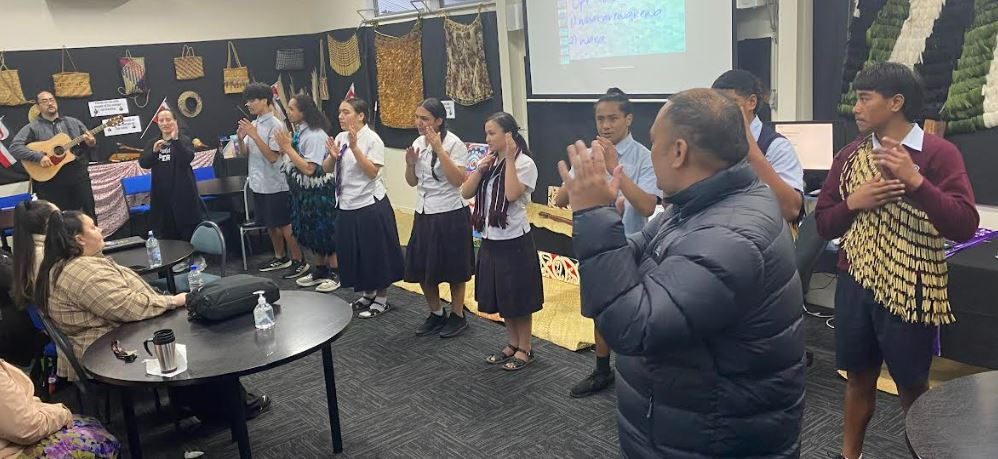
Koloa Tongan Showcase @ TC for Tongan Language Week 2023

During the PLD, they shared other takes and interpretations on what the 'vā' is. There was one that I resonated with, "simply interpersonal relationships" (Thaman, 2003). Interpersonal relationships are seen in how people communicate and act with each other within their own cultural and social spaces. They also shared what 'Vā - Tauhi Vā' means and the way in which they nurture relationships. "Tauhi-vā then is one of the fundamental elements of the four golden values or pillars of Tongan culture known as “faa‘i kaveikoula” (Mele Suipi Latu). She also explained 

Vāoif (when the vā is nurtured - tauhi - then the relationship is ofi - close)

Vā mama'o (lack of engagement or the there is distance in the relationship)

As I continue to learn and grow in my culture, I am understanding the importance of 'vaofi' - presence and commitment - to a relationship and how this helps to strengthen the relationship. 


Fakakaukau

Reflection

We were asked a series of questions to help us reflect on the relationships that we have at school and what we do to take care of the vā in these relationships with our akonga and colleagues. The relationship I chose to highlight was the relationship between myself and the students in my Whanau House Group. 

Describe or explain your relationship

The relationship is centered around my role as Dean - taking care of the students. The students come to me for a range of issues and concerns. The relationship is driven by a balance of transactional and transformational leadership (on my part) - I am trying to build my service through transformational leadership (bottom up). 

How successful is your relationship?

This is not something I reflect on too much. But I believe that there is a mutual respect between myself and my students. I feel that this makes the relationship successfull - we understand each other's place, no boundaries are crossed and there is a mutual love and respect there. 

How do you keep or nurture your relationships?

Constant communication and staying connected. As their Dean, I believe that it is important that I am across everything when it comes to their journey at school - from academic, pastoral, learning, behavior  - I try my best to stay across it all and communicate with them clearly. Creating clear expectations and boundaries is something that I do and I believe that this helps to nurture the relationship because my students understand and know their place. It works for me as well. 

Any need for improvement? How?

There is always room for improvement. I think my presence is important so making sure that I am available to my students. I also know that I can continue to ensure that my communication is constant, clear and concise with my students. 

Totara House @ Tongan Language Week 2023

Totara House @ Tongan Language Week 2023

I have enjoyed learning and understanding what the vā means in a Tongan context. Although there are many similarities, I appreciate the differences as well. I see how important tauhi va is in Tongan culture and I have seen it in action here at school through the Tongan Parent's Association and the Tongan Polyfest group. I love learning about cultures as it helps to strengthen and affirm what I know about mine. 

Sunday, September 3, 2023

Week 8 Term 3 - Totara House: Leadership + Legacy (September 4 - September 8)

Totara House Leadership 2021, 2022 + 2023
 It is that time of the year where we start preparing for our new student leadership team for each house. Our Whanau House system is anchored by the student leadership team who are the hands, feet and eyes for their respective House. I find this time of year both challenging and exciting. Challenging in that I need to start to let go of the current leadership team and exciting in that I can start to work with and usher in the new leadership team. In Term 3, the Year 12 students apply for leadership and undergo leadership interviews. The students and staff vote for their House leaders at the end of Term 3. This year there are two year 12 classes in my House and from this we have 15 students who have applied for a leadership role for 2024. 

At our most recent House assembly, we focused on 'Leadership and Legacy'. I wanted to shed some light on 'leadership' and 'legacy' and what it means in our House, school, family, community and world. I am really grateful for the fact that since the introduction of the House system to our school in 2021, I have been able to help build our young people and transition them into leadership. From Year 9 - Year 13, I like to use all the students in our House assemblies and to lead the different House events to give them the experience. With the leadership teams supporting and anchoring this approach. Two of the House Prefects for 2023 spoke about 'Leadership' and 'Legacy' and what it means to them. 


LEADERSHIP
Leadership is the ability of an individual or a group of people to influence and guide followers or members of an organization, society or team.

Leadership is a call to serve. In my opinion it is not about self but about others, building others and supporting others in the process. In Week 6, I attended an online PLD - Rauhuia Terenga/Symposium explores Pacific Perspectives on Leadership. Hosted by Dr Michelle Johansson and Melanie Cottingham, they shared their thoughts on how teachers and educators can connect with other leaders and traverse the vast oceans between our unique contexts in education. I was particularly interested in a point that Dr Johansson raised when she said that " In Pacific society, leadership just happens. Pacific peoples hardly ever ‘set out’ to become leaders - often it is accidental, or inherited. Sometimes it is thrust upon us. Understanding how Pacific leadership works can be a powerful tool for teachers." I appreciate that leadership is not something that many of my akonga see themselves in, it is something that is often inherited or asked of them. There is a deep sense of service and responsibility that my students carry when they are given leadership opportunities.

Totara House Prefect/Head Boy 2024 - Christian Kava

Totara House Prefect and Head Boy 2024 - Christian Kava - shared his perspective on leadership at our most recent House assembly. "Leadership is the ability of an individual or a group of people to influence and guide followers or members of an organization, society or team. What leadership means to me is someone who supports and encourages others. Also a good example for others to follow. To those Year 12s who are going for Student Leader application for next year, I wish you all the best. I know you guys will do well." 


LEGACY
the long-lasting impact of particular events, actions, etc. that took place in the past, or of a person’s life.

Creating a legacy is something that I have tried to build into Totara House. We are a House that is anchored in our own House values, a sense of togetherness in both the events that we participate but also in our learning journey. Over the last three years, the legacy has been underpinned by the House values that the students have come up: 

2021: Teamwork, Respect + Family

2022: Unity, Resilience + Confidence

2023: Leadership, Gratitude + Integrity

We use these values as a measure of how we present and act (individually but also as a collective) at school. Creating leadership opportunities for our students beyond Year 13 and into our junior school cohort is something that I want to continue to build into our legacy. The beautiful thing about legacy is that it is something that is continually evolving and growing. 

Totara House Prefect - Alo-Ki Hingano

Totara House Prefect 2024 - Alo-Ki Hingano - shares his perspective on on legacy at our most recent House assembly. "Your legacy is the total of your life experiences, beliefs, values, and traditions passed down from generation to generation. It is the good, bad, and everything you leave behind. What it means to me is thinking about what you do at school and hope that you can do good for others to carry on in your name. To the Year 12s, good luck and all the best." 

Year 12 Student Leader Applicants - Totara House

Year 12s with some of the Totara House Leadership Team '23

Our leadership and legacy assembly has become a staple assembly in Term 3 throughout the years. It is an opportunity to reflect on what it means to us and to also look forward to what it could potentially look like for our future. I am excited by the potential that the young people bring to the House each year. I am inspired by their enthusiasm and excitement. I am also really grateful for the leadership team of 2024. I look forward to finishing the year off well with them. I look forward to bringing in the new team to help transition our house into 2024 with ease. 

Week 1 Term 3 - English Department: Term 2 Review (July 20 - July 24)

As Term 2 has ended I find myself reflecting on what has been a remarkably busy and long journey. It has been a term defined by its challeng...