Sunday, August 27, 2023

Week 7 Term 3 - Teacher Practice: Designing our new NCEA Level 1 English Course (August 28 - September 1)

TIMATANGA 
(noun) beginning, starting, introduction, start, commencement

Since 2021, the English Department have been working on understanding the new NCEA Level 1 curriculum refresh. We spent 2021 and 2022 getting familiar with the internal and external assessments. Our focus was to learn and get familiar with the assessments - to go backwards and understand what our finish line looks like. I have enjoyed the journey and wanted to document it, so I have included my blog reflections below. 


HAERENGA
(noun) journey, trip, parting

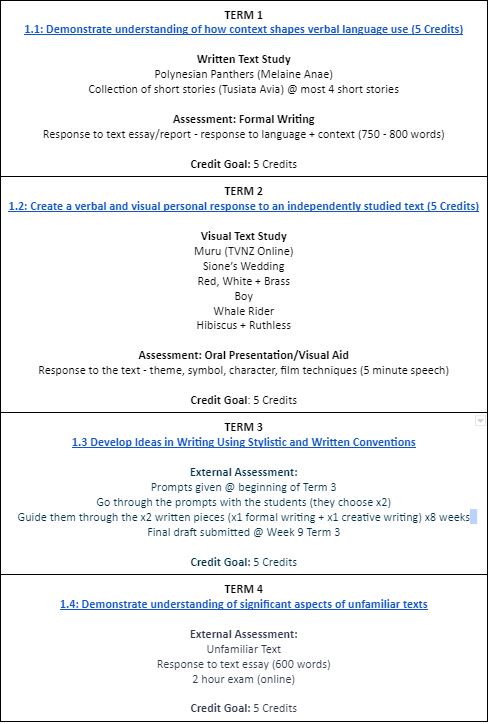
This year we have come together as a department to organize our our year planner and sort out what each term looks like. We came up with the first draft of our year planner in May Term 2 2024. See the plan below. 

1st draft of NCEA Level 1 English Plan
We built our first draft of our plan around the achievement standards. The learning and teaching filtered from the assessment. In line with our current NCEA Level 1 course outline, this plan basically mirrored the same structure - it is assessment driven with the learning and teaching supporting but ultimately the assessment is the heart of the course. Once the first draft of our NCEA Level 1 English Plan was complete, we left it for a bit. I came back to look at it and I felt that something was not right. It was from here that I looked at our current NCEA Level 1 Course Outline that we have been using since 2017. 

Current NCEA Level 1 English Course Outline
The course description - the introduction and overview of the course - was the first indication that I knew that I had to change the entire mood, tone and heart of the course. Here is an excerpt from the current course description "Welcome to Senior English! This year is all about getting used to the NCEA system. Your ears will be ringing with words like deadlines, checkpoints, credits, literacy, numeracy, internals, externals and endorsement! Don't despair - there is enough time and support, both in and out of class. You just have to do the mahi and ask if you are seriously struggling. Just remember that in the end the consequences of not asking, or falling behind because of poor time-management, will be your own." The languaging in our current course is does not reflect the big ideas or values that underpin Te Mataiaho (The Refreshed New Zealand Curriculum). The languaging does not evoke any type of inspiration or engages with the learners. The languaging of the course description and the course itself, mirrors the current state of the English curriculum which is heavily influenced by assessment for learning. It was from this point that I decided to put our first draft of our plan aside and start building a new course that is anchored in Te Mataiaho and mirrors what I want for our Year 11 students to get from English and what I believe will inspire my colleagues and department as a collective. 

TUPU 
(verb) (-ngia,-ria) to grow, increase, spring, issue, begin, develop, prosper, sprout, originate


The two questions that I asked myself were - What do I want our Year 11 students to get out of English in 2024? What will inspire my colleauges? Immediately I reflected on how our students are really drawn to stories and histories about our people and community. I thought about the importance of local curriculum and building in the cultural narrative in our community into our school curriculum and life. I thought about how as teachers of English literature and language, we encourage our students to use their voice in their writing. A theme was a coming through in my reflection and I wanted to center the new course around a theme. 

With this in mind, the theme for our NCEA Level 1 English course for 2024 is 'Our Voices, Our Stories and Our Histories'. I wrote the course description and aligned it with the big ideas and values from Te Mataiaho (The Refreshed New Zealand Curriculum). I wanted to make sure that the course description mirrored the heart of the refreshed curriculum even moreso I wanted to make sure that it was inspiring and motivating for our students and staff.

Course description for 'Our Voices, Our Stories and Our Histories' - 

Your voice, your opinion, your experience and your story matters. Your voice and your story is a gift and one that you should treasure, take care of and nurture. This year we will journey together in learning about:

We will look at Our Voices, Our Stories and Our Histories - the stories and experiences of Aotearoa New Zealand.
We will focus on Our Voices, Our Stories and Our Histories - the stories and experiences of those outside of our community.
We will explore Our Own Voices - the stories and experiences of those in our community. The stories of our community in Glen Innes, Aotearoa New Zealand and in the world are unique taonga tuku iho.

 I want to ensure that it spoke to our students and empowered them to know that their voice, their story and their communitiy's history is important and valued. 

Snapshot: Term 1 2024 (Our Voices, Our Stories + Our Histories - through Poetry) 
The significant learning, learning activies and assessment opportunities, and the big ideas (understand, know and do) are the main pillars that support the learning and assessment opportunities. Term 1, 2, 3 and 4 have been organized in this way. The learning and the big ideas are the reference points. The teaching, learning and assessment will always point back to the significant learning, learning activities, assessment opportunities and big ideas. 

KORA
(location) over there, that place (at a distance), the place over there, there - a location word, or locative, which follows immediately after particles such as ki, i, hei and kei or is preceded by a when used as the subject of the sentence.


The next steps for the department is to continue to refine our course. We will be specifically looking at building our units for the internal assessments (1.1 and 1.2). I have started to plan for the assessments but I want to collaborate with the team to flesh it out. This has been a liberating journey because I am able to build a course, a curriculum from scratch. A curriculum that I hope speaks to our akonga and kaiako. I am excited and I am inspired. I look forward to documenting this journey. 

Sunday, August 20, 2023

Week 6 Term 3 - Teacher Practice: 2023 Manaiakalani Cluster in Taranaki (August 21 - August 25)

 In Week 5, I had the privilege of attending the Manaiakalani cluster tour to Taranaki. The purpose of the school visits is to connect and learn from schools and educators, to see how they are using community and other resources in their curriculum. It is also an opportunity for us to connect with other educators within the Manaiakalani wider cluster and share resources as we are all on this digital learning journey together. It is an opportunity to learn and be inspired from other educators and their realities in education. In this post I am going to reflect on the trip and the learnings that I have gained throughout my time in Taranaki. I will be using the reflection questions in this from the debrief session that we shared in our cluster meeting following the visit, in this post for my own personal reflection. 


Day 1: AWHI

(embrace) Embracing Taranaki

When we landed in Taranaki, we spent time with a member from Puketapu Hapu who shared the narrative behind the new design and art component in the New Plymouth Taranaki Airport. The cultural narrative and dimension is a integral part of the make up of the new airport furthermore it is an important part of the history of Taranaki. The artwork is designed by famed Puketapu artist Rangi Kipa. The artwork is based on the Te Ātiawa legend of whatu kura, a celestial being. The name of this celestial being is Tamarau-te-heketanga-a-rangi "who came down from the heavens when he saw a woman called Rongoueroa bathing in the Waiongana River" (www.teaonews.co.nz). 

Learning about the history behind the art @ Taranaki Airport. 

The name Tamarau-te-heketanga-a-rangi is featured across the airport, the accompanying art helps to relay the story behind the legend. I really enjoyed learning about the story of Te Ātiawa and the connection between the legend and mana whenua (people of the land). As educators, the importance of local curriculum and what it means for us as teachers, for our students and for the learning means that we need to understand the mana whenua in our own school setting. As I am on my own journey learning about my local iwi and their history in Glen Innes as well as discovering and learning about my own connections and roots in Samoa, I welcomed this time. It helped to give me an understanding of Taranaki. 


Day 2: WHAKAMANAWA 
(to encourage, inspire, instill confidence, give confidence to, reassure, stimulate, support, rely on)

In Day 2 of the tour, we visited Waitara High School. Founded in 1947, Waitara High School is a co-educational school that is located in the town of Waitara, North Taranaki. 

@ Waitara High School with Deputy Principal Hillary 

What connections did you make?

There is a beautiful, calm and warm spirit in the school. The connection that I made with this school was the clear expectations and boundaries around pastoral care. The pastoral and student support team have a system in place that has the students at the heart of the matter. As a Dean, I saw this and it resonated with me immediately. I connected with the school's journey with local curriculum, it is visible throughout the school. The history behind the local iwi and the history of the school's life is visible throughout the school buildings. From the entrance to the hallway where there are photos of the alumni, all of the head students etc - the local curriculum beyond the stories of hapu, but also to the people who are a part of the school's fabric. I loved that their past student's successes whether in education, sport and beyond is celebrated and part of their local curriculum. 

What inspired or challenged your thinking?

They have been really innovative with their timetable. How they have scheduled the learning and prioritized student and staff well-being is impressive. I was most inspired by this because it helped me to think outside of the box - beyond what I know and that I am comfortable with. This was a point of discussion for my colleagues and I when we debriefed. 

Was there something that was simply a great idea?

There are initiatives that they have put in place for student well-being and I was really interested in the initiatives and ideas that they have set in place for this. I look forward to sharing this with the rest of the pastoral team back at school. I also loved the foundation classes that they have in place for their Junior School (Year 9 + Year 10). The foundation class is created for all Year 9 and Year 10 students - it is a class that is led by one of their Primary School trained teachers - where they teach across the curriculum. There is a particular focus on the pastoral side and less of a focus on academic learning. The foundation class is a soft launch for the Junior school, to transition into college. We have been thinking of ways to improve our transition process. I really like what they have done in this particular space. My heart is full! I really enjoyed the visit to Waitara High School and the connections that I have made with SLT. I look forward to nurturing these connections in the future. 

Outside Waitara High School


Day 3: PONO
(to be true, valid, honest, genuine, sincere)

@ Spotswood College Day 3

On Day 3 of the tour, we visited Spotswood College. Founded in 1960 ,Spotswood College is a co-educational school that is located in the town of Spotswood in New Plymouth

What connections did you make?

The connections that I made in this tour are linked to a few things. In particular I loved that the values and kaupapa of the school is centered around Te Tiriti o Waitangi. They pride themselves as being a Te Tiriti o Waitangi led school, it is at the front and center of their school in all areas. They are on a journey to see what this looks like and feels like in their academic and digital fluency journey. I also loved how in everything that they do and how they operate as a school, underneath it is Te ao Maori and the values embedded inside of it. They work alongside the community and iwi to design and collaborate on what their school values are. Their values were gifted to them from Te Atiawa (Whakawhanaungatanga, Manaakitanga, Whakamana and Pono). 

What inspired or challenged your thinking?

The journey that they have embarked in integrating the local curriculum and a curriculum that is inspired by student's passions is inspiring. They know that the education system has not worked for their students and they have designed a curriculum that disrupts the traditional education system and space of inequity. I also love how they have prioritized Te Tiriti o Waitangi in a genuine and meaningful way. Te Tiriti o Waitangi is reflected in the school's decision making structure and composition. An example of this is through partnership - they strategically wanted to source, employ and partner with Maori and Pasefika teachers as they are largely represented in the makeup of the school - 34.1% Maori and 33.7% Pasefika. The kaupapa behind this was that they wanted to provide a visible example of Maori and Pasefika excellence, that their Maori and Pasefika students can see themselves through their teachers in a professional capacity. 

Was there something that was simply a great idea?

They were very honest in how they have moved away from PB4L as it is a prescriptive lens and way of setting values, restorative and support systems. They have worked closely with the local hapu to make sure that their values and inquiry practices aligned with Ngati Te Atiawa views and values. I am inspired by the innovation that this school has embarked on. They have been unapologetic in their kaupapa and have done everything to create an environment and curriculum that speaks to them, their students, community and staff. I loved how they have managed this huge shift, as it is not easy. 


Day 4: HAUTUTANGA
(leadership)

On Day 4 of the tour, we visited Coastal Taranaki School. Founded in 2005, Coastal Taranaki School is a co-educational school that formed through a merger of a number of primary schools and Okato College. It is located in New Plymouth and caters to Year 0 - Year 13. 

@ Coastal Taranaki School

What connections did you make?

I really loved how they have walked the talk when it comes to fully immersing themselves with Manaiakalani. They have made this an integral part of their kaupapa and they have ensured that this is a priority across the school. I was particularly connected to the library space - the school has funding to use the library for both the school and as a community library. The librarian is an integral part of driving the reading, I loved how she knew all of her students and what type of texts they like. She has texts that cover all of the reading interests for all of the students in the school. The parents and elderly are also encouraged to come into the library and read with their students and also for their own enjoyment. 

What inspired or challenged your thinking?

I was inspired by the texts that are available in the library. I asked her what texts her older students are drawn too and they are particularly interested in coming of age texts, graphic novels and also texts that are reflective of what our students are going through. This has made me really think about the texts that I offer in my curriculum and it has challenged me in way that I can curate reading experiences for students that is based on their passion rather than what the curriculum dictates.

Was there something that was simply a great idea?

The leadership all BEING the example for their students, staff and community. Something so simple but so powerful. I loved that the leadership team have not just expected change but they have driven the change in the school from all parts - with their learners and staff. 


Manaiakalani Cluster with Moturoa School Principal Mr Etuale Togia

I am very grateful for this experience. My heart is full. There has been some great learning from the Taranaki Manaiakalani Cluster tours and the connections that I have made with other kaiako has been a blessing and one that I hope to continue. I am impressed and blessed by how all of the kura that we have visited have embedded the Te Tiriti, Te Ao Maori values, cultural narrative, local curriculum and histories into the life of their schools. I am encouraged by how each kura, the staff and students are walking in their local and cultural truth. I am also encouraged in the honesty that they have shared with us in that not everything is perfect, but they are journeying through this together with their akonga. The student agency in their learning has been a highlight. I have also enjoyed seeing how each kura are building rich literacy practices in all of their classrooms. I know that all middle leaders have to model this in our own classrooms and show what is expected by actually doing it to be an example to our teams. I have returned to Auckland ready to unpack the learning and action the learning into my context. 
Sunday, August 13, 2023

Week 5 Term 3 - Teacher Practice: Inquiry 2023: Learning Visual Text Literacy (August 14 - August 18)

Teacher Inquiry 2023: Improving reading and writing engagement with my Year 9 students through creating mixed ability groups within my Year 9 class. 

Throughout Term 2 my inquiry explored different reading and writing literacy strategies with my focus class 9TKl. Term 2 was a time to help ground my students with the basic literacy skills in the hope that it would engage them and make them feel comfortable and confident in their own literacy journey. Across Term 2 my focus class were working in their writing groups and focused on unpacking texts, reading in chunks, identifying key vocabulary, learning different aspects of written texts and crafting their own written text. I have documented their journey so far and it has helped me reflect on my own practice - seeing what areas that I need to cover and also appreciate the progress that they have made. See the journey that I have documented below: 


The focus for this term is Visual Text. The students have spent the last week studying the full visual text (Disney's Encanto). Prior to the full visual text, I wanted to introduce the visual text language to the students so that they knew what it was before we launched into the full film study for Encanto. I decided to do a short film study to help introduce the students the key language features (visual techniques) for film. 


THE VISUAL TEXT: TWO CARS ONE NIGHT


The film that we watched was Taika Waititi's 2004 'Two Cars One Night'

Two Cars One Night (Dir: Taika Waititi 2004)

The response from my students to this text was positive. They enjoyed the text because it was 'easy to follow', 'a love story - I like those stories' and 'it looked and sounded familiar'. When a text resonates with your students, as a teacher - this is gold! We spent one session watching through the film twice, with a break in between to discuss the following questions around the film (the questions were all plot based as the students had done plot analysis for their written texts in Term 2). The questions we looked after the initial viewing were: 

  1. What is the name of film? Who directed it?
  2. What is the film about?
  3. Who is in the film?
  4. What type of person is the male character? Describe their personality.
  5. What type of person is the female character? Describe her personality.
  6. Where is the film set (where does it take place)?
The students discussed these questions in their groups and then there was an opportunity for them to feedback to the whole class. As this was a common practice in Term 2 with the written texts, navigating and managing the discussion this time around was good because the students new the expectations. The questions - although not linked to the visual text language features focus - gave me an idea on my student's understanding of the text and how they respond to visual texts. 


VISUAL TEXT LANGUAGE FEATURES


After our discussion I used the next two sessions going through film techniques. Film literacy is an important set of literacy aspects that the students need to know. Film study is a staple in both our Junior and Senior English programs. It is important for our students to know the film language features - their function, effect and impact in the film overall. 

Film Technique Presentation

This a film technique presentation that I have linked and used my film study workspaces and that is also on my Google site (link here). I went through this with the students and we spent time going through each camera shot, angle and technique. I was surprised as there a few students who had already covered this in Year 8. 

Camera Shot/Angle Task

From here the students worked on the Film Techniques document focusing on the shots/angles from Two Cars One Night. The students had to write the definition for the camera shots/type and then screenshot an example from the film to accompany their written definition. This was a good exercise because the students were able provide two definitions (written and visual). 

Student exemplar for the Film Techniques 

The short film study was a great segue into the full film study. The students were able to identify the film techniques when we started Encanto this week. We have one more week of looking at film techniques in Encanto and then I start preparing the students for their assessment. I am excited that they are building their literacy skills with film techniques. They are able to identify the key camera shots and what mood/emotion is associated with the shot. I am wanting to link this to the director's purpose and how this impacts the audience. It may be a little ambitious, but I am keen to start navigating the students towards this as it is beyond the text. 

Our next steps: 
  • Complete the Encanto Film Study (Questions/Character Analysis)
  • Start the Close Viewing Assessment

Sunday, August 6, 2023

Week 4 Term 3 - Teacher Practice: Inquiry 2023: Literacy Online Tool - STEPS (August 07 - August 11)

Teacher Inquiry 2023: Improving reading and writing engagement with my Year 9 students through creating mixed ability groups within my Year 9 class 


With my inquiry this term, I have spent time with my focus class (9TKl) reflecting on their learning journey and goals (see Alby's Blog Post Entry - 23/07/23). Since then we have started our Visual Text Study Unit. For this we have watched the short film (Taika Waititi's - Two Cars One Night) and I have introduced the students to the literacy language features for the film. We will start our full film study (Encanto) this week and from here the students will complete the Term 3 Common Assessment Task: Close Viewing. Where they will choose ONE scene from the film, analyze the scene by identifying the key film language techniques and explaining their effect. My goal is to build their literacy skills through written, oral and visual texts. I will blog on this later this term. 


LITERACY ONLINE TOOL: STEPS

In conjunction with the film study, I have also started using an online literacy tool - STEPS (www.stepsweb.com). This coincides with my inquiry as my goal is to help students improve in their reading and writing engagement. This online tool is one that works for both struggling learners and confident learners. The online literacy program is designed so that each student has their own adapted literacy program according to their level. STEPS focuses on the core skills needed for reading and spelling. 

There was a pre-test that the students had to do, the purpose of this pre-test was to tell me where they are currently sitting in terms of reading and spelling. The pre-test also helps to generate and design a reading and spelling program for each learner. The results from the test would give the students the right program according to their level. 

Since the pre-test (end of Term 2) the students have spent two sessions each week on STEPS. It is an easy site to navigate and the students are able to complete the reading and spelling modules at their own pace. Each module is interactive and user friendly. The student's response to this has been positive, a feature on this app is that the students are awarded with either a Bronze, Silver or Gold medal at the end of each module.

Student Profile from my inquiry class 9TKl
The student profile is accessible to both the student and teacher. This is a great feature of the app as it gives the students an overview on what they have achieved and it is strengths focused and mana enhancing - celebrating their strengths in reading and spelling. The STEPS website explains the Student Profile in depth here: 

StepsWeb will tell you everything you need to know about individual users.

For any selected time-period, you will be able to see and print a profile which gives you:
  • How many medals the learner has achieved.
  • Exactly how they have spent their time!
  • Any work which has been done or assigned.
  • Detailed logs, including every error made.
You will be informed of your student’s accuracy for:
  • Reading and Spelling.
  • Comprehension and Language.
  • Phonic Knowledge and Skills.
You’ll also be able to see test results and any certificates gained by the student.
Overview of class progress on STEPS
As a teacher, you can see the overall progress for the whole class and you can monitor and track their learning with them (in real time). 

In relation to my inquiry, this online tool is an awesome addition to my inquiry journey. It has been a success in the classroom. I do know that it is only a tool and not the sole answer in helping to engage my learners with reading and writing. It is a journey so I am learning about this app, about my learners as much as they are learning in their literacy journey. I am hopeful that this will influence their engagement with reading and writing. I look forward to recording the journey and to also reflecting on their literacy journey with learning about the language techniques in film. 

Sunday, July 30, 2023

Week 3 Term 3 - Teacher Practice: New Literacy CAA Standard - Preparing our students for the new standard (July 31 - August 04)

THE JOURNEY SO FAR

The new curriculum refresh roll out is around the corner. From 2024 the new NCEA Level 1 curriculum will begin and the new set of standards will be released. In 2021, the English Department has started to look at and unpack the new NCEA Level 1 English internal and external standards. We have a fair idea on what each standard is and how we want to integrate that into our existing NCEA Level 1 English program. Since our initial discussion in 2021, we have had productive planning meetings and sessions, unpacking and exploring the curriculum for NCEA Level 1 English. I have reflected this in my earlier blog posts. 

Alby's Blog Entry Post - 30/04/23

Alby's Blog Entry Post - 13/11/22

Alby's Blog Entry Post - 24/08/22

Alby's Blog Entry Post - 16/05/22

I look forward to reflecting and documenting the progress that has been made since our last look at the new curriculum in April. The new curriculum sees a significant change in how many credits that they students need to achieve to gain NCEA Level 1 - with less assessments which means less pressure on students to produce and more of a focus on the learning and creating. In 2024 NCEA 1 changes are as follows: 

  • To gain Level 1 you will need 60 credits from a set of new achievement standards
  • 10 credit literacy co-requisite
  • 10 credit numeracy co-requisite

If a student does not achieve the 10 credits Literacy or Numeracy co-requisite, they cannot pass NCEA Level 1. The 10 credits for Literacy and Numeracy are separate to the 60 credits so students need to pass both the 10 Literacy and Numeracy co-requisite credits and the 60 credits (80 in total). Currently students must pass 80 credits (10 Literacy + 10 Numeracy credits) are inclusive in the total 80 credits. The changes to the new NCEA refresh for Level 1 are big and it does change the course of how we are currently doing things. 

WHERE ARE WE NOW?

Literacy Group with Mr Milford Week 2 Term 3

We have started the journey in looking and drafting a plan for the new NCEA Level 1 English refresh. My focus now is on the Literacy CAA Co-Requisite assessment. This year I have decided to do a trial run of the new Literacy CAA Co-Requisite assessment. I have selected 21 students from our current Year 10 Cohort who achieved between high Level 4 to low Level 5 for asTTle Writing (Term 1). It has been suggested in the feedback from the pilot schools that students who are at high Level 4 to low Level 5 for asTTle Writing are encouraged to do the co-requisite assessment. In our current cohort of Year 10, we have 21 students who are at the appropriate level. I have linked in the two assessments that (Unit Standards) the students will be sitting in Term 4. 

This term, we have started to prepare the students for the assessment. We meet with the students once a week (hopefully we can meet with them twice a week closer to the assessment date in Term 4). For now, we meet with them on Monday in the afternoon. Mr Marc Milford (literacy expert) and I are working with this group. We are building the unit as we go, but we have an idea on what we want to do over the next 7 weeks in Term 3. 

We have decided to take a thematic approach to the preparation. Instead of just giving our students random reading and writing tasks, we wanted to hone it in and provide a more structured program that focuses on a topic or theme. The theme that we have chosen is Our Community, The Community. The inspiration around this is based on the community facility prompt that the students chose for the asTTle Writing Term 1 program and also there was a community focus in both the reading and writing pilot that took place in 2022 and the beginning of 2023. The topic is broad enough to pull on student's experiences and we can create or gather resources that are readily available to us. 


Reading Focus: 
  • Get a range of texts (Continuous + non-continuous) and also pulling exemplars from asTTle to unpack with the students. 
  • Vocabulary - look at meaning of words from a text (academic/vocab lists) look at meaning for the words from the sentence, context definition for the word, word attack skills - there is a method of working out the sentence to find out what the word means, find clues within the word to find out the meaning of the word 
  • What we need to focus on - Reading Assessment Specifications
  • Do reading intensive for x2 weeks focusing on - Who wrote this text? Why did they write this text? Who did they write this for?

Writing Focus: 
  • Follow up with a writing task (see writing task below) x2 weeks
  • What we need to focus on - Writing Assessment Specifications
  • Candidates will be required to produce two pieces of writing in response to stimulus material chosen from a range of options provided by NZQA. The two pieces will be of different text types, and one will be in a formal register. Text types may include (but are not limited to): letters, reports, articles, blog posts, profiles, descriptions, explanations, and opinions.
  • Write - linked to themes from the assessment
  • Differentiated writing tasks -
  • Writing a letter (formal letter)
  • Peer review writing

Our plan for Term 3 is: 
  • Week 3 - Our Community - Reading (asTTle Letter exemplar 1)
  • Week 4 - Our Community - Reading (asTTle Letter exemplar 2)
  • Week 5 - Our Community - Writing task (write a letter)
  • Week 6 - Our Community - Writing task (write a letter)
  • Week 7 - The Community - Reading - ask for P4 Monday for x2 reading periods
  • Week 8 - The Community - Writing - ask for P4 Monday for x2 writing periods
  • Week 9 - Practice Test
  • Week 10 - Feedback to students 

Everything about this learning program is new. I am open to and embracing the journey, a journey I will be learning WITH the students. I am looking forward to seeing how each week goes and in particular I am looking forward to the practice test in Week 9. That will tell me where the students are at and what next steps we need to take going in Term 4 in the last weeks before the actual assessment (slated for November). I also look forward to documenting the journey and sharing it with the English Department. I am hoping that once the trial is done, I can share the unit and the learning with the Department so that they can work through this with their Year 10 and Year 11 cohort next year. 

Sunday, July 23, 2023

Week 2 Term 3 - Teacher Practice: Inquiry 2023: Term 2 Reflection + Term 3 Goal Setting (July 24 - July 28)

My inquiry journey in Term 2 was awesome. I really enjoyed the learning experience with my inquiry and in particular with my focus group - 9TKl. I felt the need to reflect on the journey with the students, before we venture into the program for Term 3. 

Starting the new school term with the right attitude, spirit and mindset was the focus for the inquiry and inquiry group (9TKl). This week we spent two sessions going through our Term 2 Reflection + Term 3 Goal Setting Document. The purpose of this document is to: 
  1. Get the student to review their learning journey by accessing their learning achievement data online (via KAMAR Student Portal)
  2. Reflect on their learning journey
  3. Set goals for the term
I created this document last year and used it with my junior class. I made some adjustments to the document, so that the student can dig deep into their learning journey and unpack it to see what it means for them. We spent our afternoon class on Tuesday going through the document, the students went through the document individually. On Wednesday, the students got into pairs and shared their reflections with each other. The were given the task to provide positive and affirming verbal feedback. The students were able to learn about their peers and also affirm their reflection and goals. 

I will explain the three parts of the reflection/goal setting document and what it is about. Then I will share some highlights from my student's responses. 

LEARNING JOURNEY REFLECTION: Results


I believe that it is important to know your learning journey and what you have achieved in the journey. It helps to give both kaiako and akonga a sense of grounding and an idea of what they have been able to accomplish. It is important for my students to know their learning map and to see what they have been able to cover over the year. 
Term 2 Reflection: Looking at their learning and results. 

In Week 1 of Term 3, the students looked back at their results from Term 1 and Term 2 English. They did this by logging into our student portal where they can see their current results across all of their subjects. This is readily available for our akonga at any time but for the most part, they do not engage with it. I wanted to use the time at the beginning of the term for the students to have a look at what they have done and achieved ultimately to appreciate their progress and journey. 

Here are some responses from my inquiry group. 

"The curriculum level that I need to be at is Level 4. The curriculum level that I am at for this is level 4. I am happy with this because I am always happy to see good grades. I know getting a level 4 is standard but I want to push myself in reading to get a higher mark."

This level was the best for me cause i made an easy formal writing.

"The curriculum level that I need to be at is Level 5.
The curriculum level that I am at for this is Level 4.
I am happy with this because this is the level I should be at.
What I want to do to improve is study more at home and manage my time."


LEARNING JOURNEY REFLECTION: Academic Reflection


Here the students were able to delve into their reflection and talk about what worked and what did not work. They were able to review this and revisit the steps that helped them to achieve but also be aware of the barriers to their learning. 
Term 2 Reflection: Reflection on their learning achievement and challenges
Here are some responses that were highlighted for me. 

"What did you enjoy about school in Term 2? Why?
I liked how everyone was used to everyone and was comfortable
What didn’t you like about school in Term 2? Why?
I didn’t like some of the subjects and teachers but I settled in
What can you do to improve in school in Term 3?
My learning and to improve all my skills in learning and to stay on task""

"What did you enjoy about school in Term 2? Why?
I really enjoyed term 2 because I got to know my peers a lot more than I already knew .
What can you do to improve in school in Term 3?
I want to improve on all of my subjects"

LEARNING JOURNEY REFLECTION: Personal Goals


Setting goals gives you a finish line to work towards. Although reflecting and setting goals is something that my students seldom do, bringing the practice and language around it can help and open them up to it. Also intentionally asking them questions where they have to think about their intention, how they see themselves - can help them really understand the power that they have in their own learning. 
Term 2 Reflection: Personal Goals

 Here are some of the highlights from my student's responses. 

"What did you learn about yourself last term?
I learnt that I need to work harder in certain subjects to get better marks
What did you learn about yourself as a learner last term?
I learnt that I can get very good marks if I stay focus but I also if I can maintain great work ethic as well
What is something that you did last term that you liked or that you are really proud of? Why?
Although I didn’t do so well in my reading test I was very proud of my writing results cause I now will try very hard to maintain a level 5
What are your goals for Term 3?
If we have exams I want to achieve high and if we don’t I want all of my work to be at above standard or at its very best ethic. I want to change my perspective towards school by prioritizing my time at home as well as in a school environment."

As we launch into our new unit of learning for Term 3 (Visual Text Study) I wanted to stop and spend time reflecting with the students. I enjoyed doing this activity with them and I also enjoyed seeing them interact and affirm each other when they were reading each other's reflections. 

Next steps - Week 3 - Week 5: 
  • Start Visual Text Study - x1 short film and x1 full film study
  • Learn visual techniques + effects. 
  • Assessment: Close Viewing

Sunday, July 16, 2023

Week 1 Term 3 - English Department: Term 2 Review + Plan for Term 3 (July 17 - July 21)

Term 2 was a challenging term to say the least. As a department and as a school, we were teaching in a time where PPTA Strike Action was taking place and our students were in and out of school. Despite all the challenges that we faced, we finished the term well. I would like to thank the entire English Department team - Ms Anahina Latu, Mrs Pravina Harde, Mrs Christine Williams, Mr Faiyaz Hoosein, Mr Jeremy Spruyt, Ms Francis Kolo, Mr Marc Milford, Mrs Viviene Jenson-Jones and Dr Jannie Van Hees - thank you for your time, hearts, commitment and service to the English Department and to your students. My job is made so much easier because of you. Thank you all!

Here are some highlights for the English Department Term 2.

  • English Department Monday morning (Term 2) - We have enjoyed our Monday morning meetings during Hybrid learning. It is a time for us to come together and to regroup. It has been helpful for us to get on to the same page, to learn from each other and share in each other’s journey throughout the term.

  • Teacher Only Day (Week 6 Term 2 - June 2 2023) - The Manaiakalani Cluster Teacher Only day took place at the end of Week 6 Term 2. The primary focus of the TOD was 'CREATE' specifically 'Creativity Empowers Learning' - For Manaiakalani Create/Hanga is built on engagement and empowerment. How are we harnessing Create to motivate our learners to ENGAGE with reading to learn and learning to read?

  • Teacher Only Day (Week 2 Term 2 - May 1 2023)  For our most recent TOD, we used this time to focus on the changes to NCEA Level 1 English program and to continue our discussion around the new achievement standards. We spent time revisiting the new achievement standards that we covered in 2022 and also explored the new external assessments that are on offer. We were able to do this as well as flesh out a draft plan for our new NCEA Level 1 English program 2024. We used TOD to feedback about the external assessments. Much like what we covered last year, the department looked at the same five areas when unpacking the assessment -
  1. What is the assessment?
  2. Keywords and concepts from the assessment
  3. Opportunities
  4. Potential barriers
  5. Next steps
The department was broken up into two groups - each group looking at the new achievement standards (1.3 and 1.4).

We will now review our Term 2 Junior and Senior English program.

JUNIOR ENGLISH PROGRAM TERM 2 REVIEW: 

Junior English Program Term 2


Our focus for Year 9 and Year 10 English was Short Text. We spent the term going through our first text study for 2023. Some of the texts that were covered this term were:
  • Jillian Sullivan - Dear Ex Dad (Year 9 English)
  • Alicia Keys - P.O.W (Year 9 English)
  • Witi Ihimaera - Big Brother Little Sister (Year 9 + Year 10 English)
  • Andy Mulligan’s - Trash (Year 10 English)
Following the short text study, our students worked on our CAT (Common Assessment Task) Creative Writing. The students were engaged with the Creative Writing CAT and we are pleased with the results. We are hoping to close the loop with students who were not able to complete it during the first week of Term 3.

Below are some examples of the creative writing from our akonga. Their understanding on how to craft a creative text and how they used their narrative voice was impressive.
Student exemplar 1 - Creative Writing Tamaki College Term 2

Student exemplar 2 - Creative Writing Tamaki College Term 2
 

SENIOR ENGLISH PROGRAM TERM 2 REVIEW


Senior English Program Term 2

The focus for Term 2 for our NCEA Level 1, 2 and 3 students was the Extended Text Study. For NCEA Level 1 English we focused on John Steinbeck’s ‘Of Mice and Men’, for NCEA Level 2 English we focused on Doris Lessings ‘The Grass is Singing’ and for NCEA Level 3 English we focused on Tim O’brien’s ‘The Things They Carried’.

The focus assessment for our NCEA Level 1, 2 and 3 students for Term 2 was our written assessments. Our NCEA Level 1 English students worked through the Creative Writing Assessment and Create a Visual Text Assessment. Our NCEA Level 2 English students worked on the Connections Report Assessment and Personal Response Assessment. Our NCEA Level 3 English students worked through the Connections Report Assessment.

NCEA Level 1, 2 + 3 English Data Week 1 Term 2

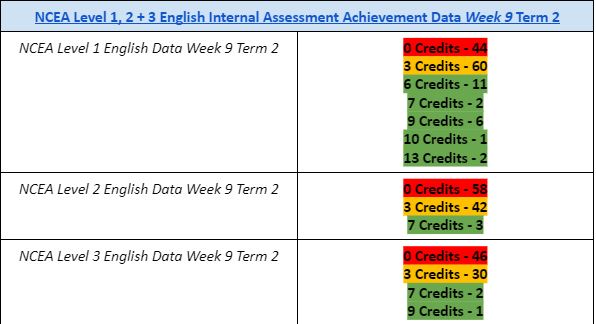
NCEA Level 1, 2 + 3 English Data Week 9 Term 2

It has been a challenge to try and get through our extended text study and assessment given the interruptions that we faced this term. But we are grateful for the shifts that we have seen with our student achievement data. We collectively agreed that we will continue to allow our students to work through any unfinished internal assessments in Term 3 as time in Term 2 has not allowed them to finish the work.

We understand and acknowledge that there are so many things going on with our senior students. Some are working, attendance is an issue and motivating students through this has become a challenge. In saying this, we are hopeful and determined to see it through with our students. We are going to continue working through the internal assessments as a focus for Term 3 as well as preparing our students for derived grade exams.

We look forward to working with our NCEA Level 1, 2 and 3 English students.


ENGLISH DEPARTMENT GOALS TERM 3


As a department, we like to discuss what our priorities and goals are. Sometimes our priorities change as we journey through the term but we try to stick to our goals as best as we can. Below are some of the goals that we would like to work towards in Term 2. 

  • Finish Internal Assessments - We want to prioritize Term 3 to helping our students finish their internal assessments for NCEA Level 1, 2 + 3 English. That means that for the majority of Term 3, our students will be working through starting and completing the final lot of internal assessments. We have all covered our text studies so we want to use the time to help our students get over the line. We will also make time in Week 6, 7 + 8 to go through Derived Grade Exam preparation.

  • Unit Plan + Design our Level 1 English Program 2024 - We have started to unpack the new NCEA Level 1 internal and external assessments. We have a draft plan on what we want the program to look like. We want to use time (hopefully during Hybrid Learning Day) to plan our units for the New NCEA Level 1 program. The collaboration and planning has already started and we have documented this in our English Department: NCEA 2024 Assessments folder. We hope to finalize our program by the end of Term 3.

  • Year 10 Literacy Assessment - The new literacy assessment will be assessed in Term 4. There are 17 - 21 students who have been selected from Year 10 to sit the trial assessment. We hope to work with these students during Hybrid Learning on Monday to teach them the literacy skills that they need for the assessment.

JUNIOR + SENIOR ENGLISH PROGRAM TERM 3


Junior English Program Term 3

The focus for our Junior English Program is our Visual Text Study (Film Study). We hope to complete the supporting CATS for the Visual Text Study - Close Viewing and Speech. We look forward to exploring visual language techniques with our students this term. 

Senior English Program Term 3

The focus for our Level 1, 2 and 3 students is to complete the internal assessments by the end of the term. We also want to make sure that our students are prepared for their derived grade exams which take place in Week 10. 

Term 3 is always a busy term and there is a lot of things that we need to complete with our senior students. I am confident in the team and I know that they are going to support our students in making sure that they cross the line. I am grateful for the team that I work alongside. All the best to all of my colleagues and students going into Term 3. 

Week 9 Term 2 - Totara House: Samoan Language Week 2026 - Understanding our House Value of Unity through the concept of Fealofani (June 08 - June 12)

Totara House SLW Au Siva 2026 The concept of fealofani in the Samoan culture goes beyond a simple gathering or coming together; it is deeply...