After culling through the Level 3 English assessments for my L3 English class, I have now started to think how I can teach the assessment more efficiantly. More importantly, how I can support a better learning outcome for the students. My first assessment to tackle - 91480 (Close Viewing).
Previously we have taught the assessment by getting our students to write an essay comparing two films by the same director. The essay structure requires the student to compare the film techniques that the director used in both films and then form an perspective on what style of film they believe the director has.
I met with Cynthia Orr who helped me think about a different approach for my Level 3 students with the assessment 91480. The new approach is to treat the assessment like:
A visual version of the L3 Unfamiliar Text external paper.
The assessment will focus largely on students being able to identify film techniques. They will watch the film 'A Beautiful Mind' together and then start a film analysis doing a close viewing for 3 scenes.
The overall goal for this assessment is for students to able to do a close analysis of film - any film - identifying film techniques, understanding the context of the film, director's purpose, cultural and societal context in and outside of the film, who is the intended audience and why.
Here are some links to the some of pre-close viewing activities that I have done with the class. Our discussion around Biopics was particularly interesting for the students. The discussion was good and they were engaged!
Biopic Activity
Close Viewing Practice
Tuesday, February 25, 2020
Friday, January 24, 2020
Back to business
Reflection and perspective is important especially for educators. When we have to face the data and External results, we must look at what worked and more importantly what did not work. We then need to look at the big picture and see beyond the number and as mentioned in my earlier post, think about your approach on you will make the necessary changes to ensure success for your learners. Perspective can have a trans-formative power in how we see, understand and approach our situation, problem, crisis and life.
Looking back at the results from the English Department 2019 - overall picture tells me that there is a need for improvement. There are gaps that need to be addressed and there are areas in our student's learning in Level 1,2 and 3 English that need to be rectified. However there was a highlight - in my opinion - a few highlights that help to bring a positive perspective to the big picture in particular a monumental highlight for our Level 1 students.
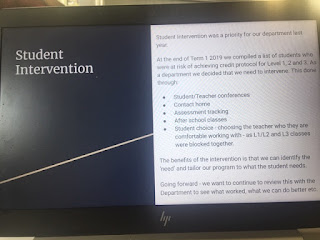
Student intervention was a priority for our department. We identified the students who were at risk of achieving at the end of Term 1. We met with the students, contacted their parents and then gave the student the choice to choose who they were comfortable working with. This proved to be successful as the students were then engaged because they were with a teacher who they felt could help them. Going forward, we will review this intervention with our department to see how they feel, what worked or did not work for them.
Unfamiliar Text - traditionally this an external paper that Tamaki College students choose not to attempt and if they do, the success rate is low. The actual skill required for this External paper is reading comprehension. Many of students start college reading and writing below the National average. As a department we knew that we wanted to change this and we wanted the students to feel confident with this External paper. We knew that before we could nurture success for the students, it had to star
t with the department. As a department we discussed our fears, frustrations and truth with this external assessment. As a department we extended this discussion with Dr Aaron Wilson and Cynthia Orr (Woolf Fisher) who came on board and provided the department with the forum to discuss with each other, provided support and PD for the department and then provided support with our Year 11 students. This intervention - for both staff and student - was pivotal in shifting in our approach to this dreaded assessment. We were honest with each other and with ourselves and this helped to break down that barrier that we face as teachers. As a result, we had 31 students pass the External assessment. We are very grateful and humbled and this was definitely a highlight.
Jump Start is a program for our Year 9 and Year 10 students that is introduced in Term 4. The program sees our Year 9 students go into Year 10 and our Year 10 students go into Year 11 starting NCEA Level 1. This was successful for the English Department - in particular for our new Year 11 students as they used Term 4 to start banking credits for Level 1. The response was positive and has been a good start for our new cohort of Year 11 students. Many of them started Level 1 English assessments in Term 3 so going into Jump Start was easy as they continued to work on these assessments, for some they were able to complete and move onto other Level 1 English assessment.
The Team - Ms George and I need to acknowledge our team who went above and beyond. Their hearts of service and desire for our students to succeed are just some of the many attributes that our journey in 2019 memorable and rewarding.
Looking back at the results from the English Department 2019 - overall picture tells me that there is a need for improvement. There are gaps that need to be addressed and there are areas in our student's learning in Level 1,2 and 3 English that need to be rectified. However there was a highlight - in my opinion - a few highlights that help to bring a positive perspective to the big picture in particular a monumental highlight for our Level 1 students.
t with the department. As a department we discussed our fears, frustrations and truth with this external assessment. As a department we extended this discussion with Dr Aaron Wilson and Cynthia Orr (Woolf Fisher) who came on board and provided the department with the forum to discuss with each other, provided support and PD for the department and then provided support with our Year 11 students. This intervention - for both staff and student - was pivotal in shifting in our approach to this dreaded assessment. We were honest with each other and with ourselves and this helped to break down that barrier that we face as teachers. As a result, we had 31 students pass the External assessment. We are very grateful and humbled and this was definitely a highlight.
Wednesday, January 22, 2020
20/20 Vision
New year, new decade.
Going into the new year, like most people, I have thought about what I want for this year both professionally and personally. It got me thinking about the concept of 20/20 vision. 20/20 vision is a term used to express normal visual acuity (the clarity or sharpness of vision) measured at a distance of 20 feet.
The 'clarity of vision' that I am hoping and praying for this year is to:
Move - Faith without works is just words. I want to 'move' - in the sense that I want to action and work towards my goals, dreams etc.
Multiply - I am blessed, I want to continue to be expectant but also hungry with my goals. I want to work hard so that I can multiply my chances in getting what I want to achieve.
Maintain - I want to maintain the same work ethic and values in everything I do, say and action. I also want to maintain and nurture all of relationships - family, friends, church, work - these are important to me.
Manifest - I want to continue to speak 'life' and declare success, even when I feel like a failure.
Miracle - Expect the great :D
With everything that has happened personally and professionally in the last 10 years, my goals - whilst not new to most people - are the very things that I need to keep me grounded. It is important to have a vision - clear or not - for yourself. I look forward to talking to my students about what their vision is for themselves this year.
Going into the new year, like most people, I have thought about what I want for this year both professionally and personally. It got me thinking about the concept of 20/20 vision. 20/20 vision is a term used to express normal visual acuity (the clarity or sharpness of vision) measured at a distance of 20 feet.
The 'clarity of vision' that I am hoping and praying for this year is to:
Move - Faith without works is just words. I want to 'move' - in the sense that I want to action and work towards my goals, dreams etc.
Multiply - I am blessed, I want to continue to be expectant but also hungry with my goals. I want to work hard so that I can multiply my chances in getting what I want to achieve.
Maintain - I want to maintain the same work ethic and values in everything I do, say and action. I also want to maintain and nurture all of relationships - family, friends, church, work - these are important to me.
Manifest - I want to continue to speak 'life' and declare success, even when I feel like a failure.
Miracle - Expect the great :D
With everything that has happened personally and professionally in the last 10 years, my goals - whilst not new to most people - are the very things that I need to keep me grounded. It is important to have a vision - clear or not - for yourself. I look forward to talking to my students about what their vision is for themselves this year.
Wednesday, December 18, 2019
2019: From my perspective
This year I have seen failure, celebrated success, restored broken relationships, gained a new and much needed perspective on life and through it all, I have learnt so much.
My perspective on life has been challenged. Challenged in a way that I have chosen not to invest my time in what I deem to be problematic (this hard, I tend to focus on what is not working and not what needs to be done about it). Instead choosing to find ways on what the solution is, how can it be fixed and who can help.
In saying this, I am truly grateful for this year. God has been so good and I pray for His hand in everything that I do and that He will continue to use me. Taking on the role as Co-HOD of the English Department with my colleague, Ms Amber George, Dean of Year 10, Teaching - everything in between - I am grateful for the experiences I have had with these roles this year. I look forward to rest and to reset and recharge.
It is an end of an era and going into a new decade, I look forward in closing this chapter. The last 10 years have been what I believe my 'foundation years'. I started working at Tamaki College at the beginning of the decade. I married my wife this decade. We had our first child this decade. I have experienced life changing heartache this decade. I have been fortunate enough to have traveled the world this decade. I have really found hope in my faith with God this decade. I am excited in what is ahead and what I am going to learn. I pray for God's continuous covering and direction. Thank you God for an awesome 2019!
Monday, November 18, 2019
Changing the tide
My perception on student achievement and learning has been challenged this year. Challenged in way where I am starting to look at the program that is offered for Level 3 English and I am starting to think what is going on? The program for Level 1 and Level 2 English are at the place where student achievement and engagement is good, not great but definitely not in crisis. For Level 3 English, I have noticed that our students are not where they should be.
I have started to look at the current program for Level 3 English. At this stage we offering the following assessments:
My view is that there is an assessment overload and that there are two assessments that our students' are not engaged with. In my planning for next year, I am hoping on cutting down on what is not needed and focus on what is working and how I can deliver it as best as I can for our students.
My plan for next year is to remove:
This leaves 91480, 91475 and 91478 as the remaining assessments. One assessment per term, this implies that the quality of the assessment is given time and the students can take their time and not rush through the assessment. This also implies that the expectation is that they do pass the assessment given the healthy time to discuss, learn, share and create in class.
I have started to look at the current program for Level 3 English. At this stage we offering the following assessments:
- 91480 - Close Viewing - 3 Credits
- 91475 - Writing Portfolio - 6 Credits
- 91478 - Connections Report - 4 Credits
- 91476 - Speech - 3 Credits
- 91479 - Critical Analysis of texts - 3 Credits
My view is that there is an assessment overload and that there are two assessments that our students' are not engaged with. In my planning for next year, I am hoping on cutting down on what is not needed and focus on what is working and how I can deliver it as best as I can for our students.
My plan for next year is to remove:
- 91479 (Critical Analysis of texts) - I believe that the analysis of texts at a critical level is already happening with through our Extended text and Visual text study. There is no need to double hand students with assessments.
- 91476 (Speech) - I believe that rich discussions should be happening in the classroom. Students should not be assessed on something that we should be doing in the classroom already.
This leaves 91480, 91475 and 91478 as the remaining assessments. One assessment per term, this implies that the quality of the assessment is given time and the students can take their time and not rush through the assessment. This also implies that the expectation is that they do pass the assessment given the healthy time to discuss, learn, share and create in class.
Tuesday, September 10, 2019
Boys in Literacy
Ms George and I attended the 'Boys in Literacy' PD lead by Marshall Diggs. Here are some of the gems that I took away from the PD. It was informative and very good!
1) LEARNING IS MORE IMPORTANT THAT THE RESULT - this was a phrase repeated throughout the PD. Sometimes as educators we can lost in the pace of assessments and deadlines that the learning can take a backseat. This phrase made me think about this very thing, what is essential in a student's learning journey - is it the number of credits or the skill and learning?
Boys engage when writing tasks involve:
- Facts - what are the facts - compare and contrast the facts around the setting and compare to the conflict in the text
- Competition
- Humor
- Survival - The Cay (Theodore Taylor) links to survival/description of survival type writing
- Conflict - Write about the conflict with the Titans and the Olympians and the radical conflict in the text
- Adventure
- Overcoming adversity - write about an experience when you overcame adversity - link to the film Wonder (Julia Roberts)
- Socially engineer the choices boys have when it comes to writing.
- Writing is about QUALITY not QUANTITY
3) SAFE SPACE - Boys thrive in a structured learning environment - they feel safe and feel free from the put down of peers.
Always speak clearly, maintain eye contact, wait for compliance, repeat and estate instructions - never rephrase, use of inclusive language is not helpful - give the boys the headline not the paragraph. Boys respond best when there is visual representations (LADS - Listen and Draw Something) and when we de-escalate tension - go shoulder to shoulder before you go face to face.
Final take away quotes that stood out for me:
"Refuse to lower your standards to accommodate those who refuse to raise theirs" - Mandy Hale
"Speak to the boy before you speak to the issue" - Marshall Diggs
"Greatest contribution to the sector is not what you teach but who you teach" - Marshall Diggs
Monday, September 9, 2019
Reflection: Quality over Quantity
Student Feedback:
What are the three important things I would like my teacher to do help me learn?
Explain, one on one teaching, competition, interact, rewards
What helps me think for my learning?
Music, food, talking, space, breaking it down into easy steps/chunks, acknowledging progress
Points for educators to think about in response to student feedback
Quality of Professional Learning Conversations
Low Quality:
- Considerable talk about student behavior
- Talk about teaching without connecting it to evidence of impact on the student's understanding of learning
- Talk about the data for the purpose of grouping students
- Talk about the data for the purpose of singling out teachers for for praise or criticism
High Quality:
- Focus on student learning and engagement, surfacing challenging issues of practice
- Talk that uses evidence as a basis for collective inquiry into relationships between teaching and learning. Talk driven by a desire to learn
- Talk that uses data for the purpose of designing more effective teaching approaches and interventions
- Use data to learn about effective practice
What are some 'High Quality' learning conversations about particular students that I can lead in my department?
- Leading Partnerships
- Learners are active participants
- What are learners good at? Build on their strengths
- Who are they? See the learner
- Doing with them, not to them
- Setting goals and developing new relationships
- Ongoing sharing
- Celebrating successes
- Summarizing learning progress at key points in time to illuminate what has been learnt and inform future learning
- Parents and whanau would like more information about their child's progress, including how they can support their child's learning
Leadership of sticky change: Fullan
- Use the group to change the group
- Precision over prescription
- Feedback candor and autonomy
- See the forest and the tress
- Accountability as culture
Acceleration by design:
Knowing your learners
- Tailoring teaching and assessments for individuals and groups
- Engaging with students' cultures and identities
- Adapting for students' literacy needs
- Adapting for students' attendance needs
- Involving whanau
Collaborating with students
- Providing choices for teachers, programs and assessments modes
- Being explicit
- Learning together with students
- Empowering students to take the lead in learning
Some ideas on involving students in their accelerated programs:
- Speak with the students
- Breaking down into achievable steps - what is achievable?
- Looking at completing unfinished assessments
- Precise feedback
- Asking the student to come with work they are confident in completing
Subscribe to:
Posts (Atom)
Week 9 Term 3 - Teacher Practice: Understanding Character - 91925 Character Essay (September 14 - September 18)
Character Profile This essay plan is designed to help you dig deep into the characters of The Dark Horse. It kicks off by setting the stage...
-
I have only just started blogging. Why? For a while, I have felt this need to write my reflections and thoughts on my teaching pract...
-
The theme for Samoan Language Week 2019 is: Lalaga Le Si'osi'omaga mo se Lumana'i Manuia (Weave an environment for a bet...
-
An important lesson that I have learnt when it comes to leadership is that there is value and power in sharing and collaborating. Each of th...


