Wednesday, July 24, 2019

Leading the change

An important lesson that I have learnt when it comes to leadership is that there is value and power in sharing and collaborating. Each of the learning areas were asked to present on how they are leading change in their departments and what they are doing in regards to student achievement. It was enlightening and encouraging to see and hear what my colleagues are doing with their team and students. Here is some of my takeaway from the presentations: 

Technology Department: The Tech Dept have responded to achievement of their students' through continual consultation. A reflection and inquiry on what the policy or process is for students' who do not meet credit protocol.
Science Department: The department are encouraged to prioritize relationship building with students as an important factor in student achievement. 
PE Department: The department credits by attaching assessments to other assessments to make it fit for the learner. Target students are constantly changing based on student's attendance, performance and completion of assessments. 
Visual Arts Department: The department shared that they want to main the current strategies used for accelerating student achievement. They also want to ensure that the senior student's are committed to the subject, provide adequate exemplars and continue feedback. 
Te Reo Maori Department: The desired outcome for all students' is to build confidence in Te Reo Maori and to engage in more explicit learning conversations with the students. 
Social Sciences Department: The Social Science Department want the students to be excited and engaged in Social Sciences. In terms of support for their target group of students' is to have intense and purposeful discussions, goal setting and understanding what motivates the student. 
ESOL Department: The desired outcome is for each student to gain credits from three standards offered in ELIP. Moving forward, relationship building and having those intense conversations is needed.  
Music Department: The course of action to help student achievement is to tailor the program to fit the student's strengths by using song writing, performance and group based activities. 
Mathematics Department: Desired outcomes to support achievement are to continue to use literacy strategies, collaborative inquiry and looking at the data closely. 

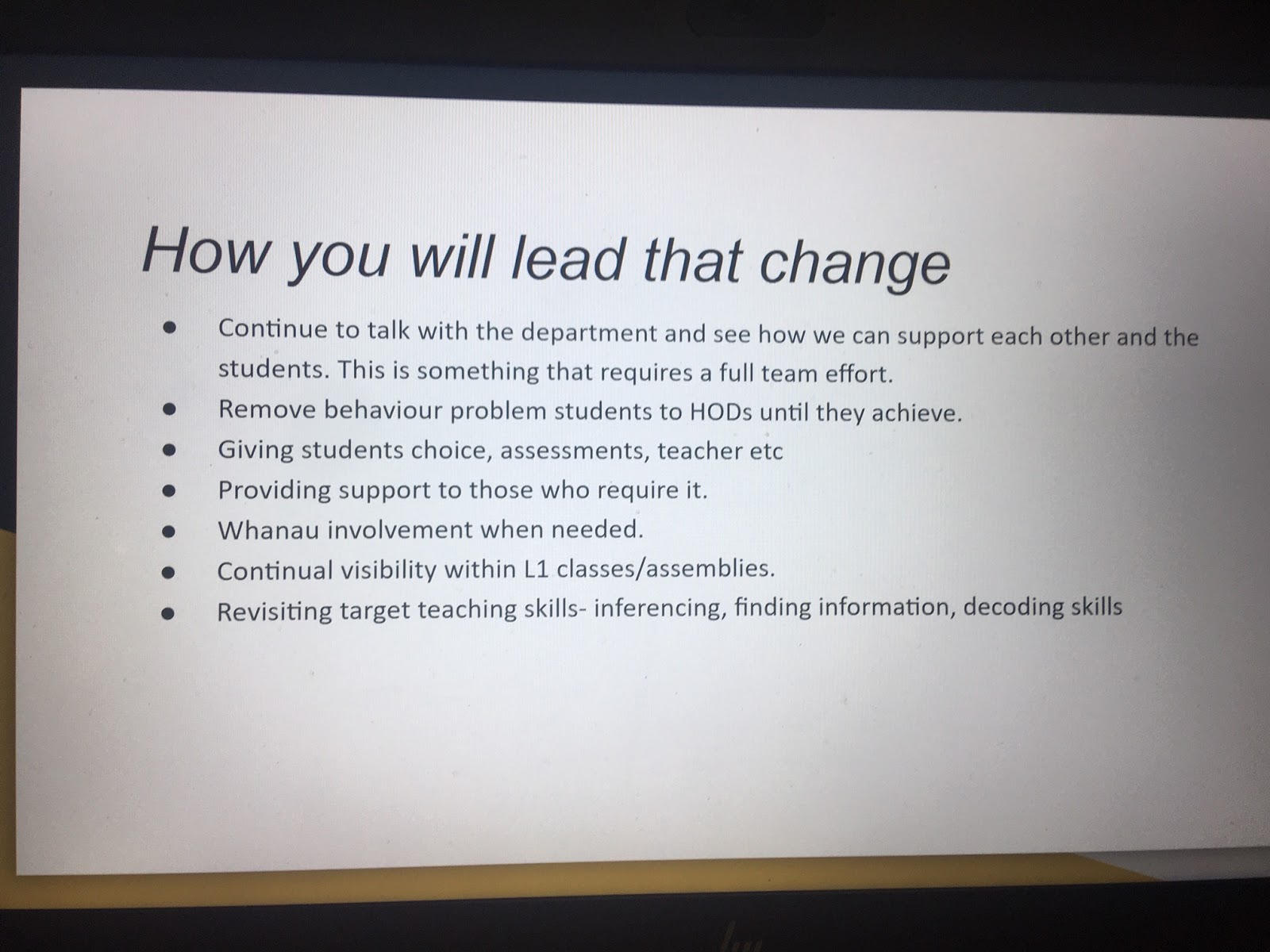
Here is the strategies from the English Department: 


Monday, June 24, 2019

Student Centered Leadership - Going further.

Our 'Why':
Revisiting our 'why' is important when you are working on making your leadership more centered around students' needs. As a department, our 'why' is focusing on the students we care for. They are the participants and benefactors of our work as leaders and teachers. 

Our 'What':
The collective goal for the English department this term is to accelerate the achievement of Year 11 students. Here a few questions that helped me reflect on what my colleague, Ms Amber George and I have achieved with the department so far with our Year 11 students. 
  • What was your deliberate act of leadership? Following up with the department, being more visiable to the students, talking with the students and having restorative conversations. 
  • What was the outcome? Credit shift (gaining more credits through intervention), there is a long way to go but the improvement promising. 
  • What did you learn? To be patient with the process, to fix what is not working straight away and the importance of clarity in communicating our expectations to the department. 

Student Voice (What the young people are saying): 
The students' were able to share their thoughts on what they want from their teachers. 

The findings is a result from conversations that were held with senior students (Year 11, 12 and 13). This is some of their responses:

  • Listen to what we want to achieve 
  • Push us to get endorsements
  • Know our skill set and abilities 
  • Comfortable environment 
  • Make our parents proud 
  • Fun work
  • Don't talk a lot
  • Explain what we need to do to get merit and excellence
  • Slow down and explain 
  • Respectful environment

Critical Perspective: 
Barbara Alaalatoa (Principal of Sylvia Park School) states that “Teachers who are connected to and know the students deeply”, “Authentically build their teaching practice around the student”, “Committed to learning about their craft and their learners” and “They make no assumptions about the learners in front of them”

The Bigger Picture: 
Viviane Robinson states "The more leaders focus on their relationships, their work, and their learning on the core business of teaching and learning, the greater their influence on student outcomes." When thinking about the bigger picture with student centered leadership, I have learnt that one of the core jobs of a middle leader is to lead the learning of the department. As middle leaders it is vital that we help to translate teaching practice into the classroom and ultimately effect and influence the team and students. 

What does effective teaching look like?
Effective teaching is collaboration with colleagues, strength based learning with a focus on students needs. The relationship with the student is an integral part in effective teaching. 
It is a commitment to the student, I believe that when you are committed to the student then you are open to change, learning, evolving and not staying static. 


Monday, June 10, 2019

Student Centered Leadership: What does it mean?

What does student centered leadership mean?

Student centered leadership can mean many things. For myself I believe that student centered leadership looks like:

Self-directed learning
My goal for my Level 3 students this year to design a program where they drive what they want to do with their writing assessments. I am looking forward to working with Cynthia Orr (Team Solutions) who will help me put this program together. I believe that if the students find texts that they are interested in, their response to the text will be more genuine. Watch this space!

Learning needs of the students drive the learning objective
Teachers taking note of the student and their needs and adjusting their program to the need. I have spoken about this before, this is something I support and endorse.

Sharing of power in the classroom
We as educators can learn so much from our learners. This is something that I am interested in pursuing. There is so much value in what our students bring to the classroom and this can be utilized in way that will enrich the classroom experience for everyone involved. I am wanting to inquire in what has worked for our students who have achieved exploring what helped them succeed and how they applied this to their studies. 

Tom Webb states student centered leadership is "leadership that makes a difference to the equity and excellence of student outcomes". Education is a source of equity for our young people. If our focus is on making the learning needs the priority and encourage the sharing of power with our learners, our leadership will be one where it is not only leading from the front but from all areas. 


Sunday, June 2, 2019

Student Centered Leadership: And so it continues....

Viviane Robinson states "The more leaders focus on their relationships, their work, and their learning on the core business of teaching and learning, the greater their influence on student outcomes."  As I read this I think about my role as an educator and how I want to be an effective leader. I believe that the core role of middle leaders is to lead the learning of the department. To translate teaching practice into other classrooms, to share knowledge that is effective for the learner and ultimately to influence the students and my colleagues.

In my previous posts I have explored the question 'what does student centered leadership look like?' I can conclude that there is not a specific answer for this. It is something the will continue to evolve and change, that is the beauty of it. It is all part of growing in learning, learning is growth, growth is important. In my inquiry I have also thought about 'what does effective teaching look like?' Is it result based? Data focused based? Classroom behavioral management? A few thoughts I have in answering these questions that do not necessarily answer the question but offer as ideas that have helped me understand what I am looking for.

  • Effective teaching is collaboration - working with colleagues to building better outcomes for the learner. 
  • Effective teaching is making the learner the most important person in the relationship. 
  • Effective teaching is everyone (student and teacher) committed to being a learner. If everyone is learning then change is reinforced, it is building each other in the process. When you are committed to learning then everything evolves. 

Friday, May 31, 2019

Samoan Language Week 2019

The theme for Samoan Language Week 2019 is: 
Lalaga Le Si'osi'omaga mo se Lumana'i Manuia (Weave an environment for a better future)

Samoan Language Week was held on May 27th and finished on May 31st. It was a week that saw our young people pray, share, sing and perform celebrating the Samoan Language. Here are some highlights from our celebration week. 


Opening prayer and blessing for Samoan Language Week. Thank you Ms Lote-Fepuleai and Ms Apelu for leading our opening ceremony. Well done to our young people for your beautiful singing! [VC: Dorothy Apelu]

Ms Robertson sharing a Samoan proverb during staff briefing. Thank you Ms Robertson for sharing this proverb with us. [VC: Dorothy Apelu]

Samoan Language Week Assembly: National Anthem.

Samoan Language Week Assembly: Taualuga (Priscilla Endermann Y13)

Samoan Language Week Assembly: Boys item

Samoan Language Week: Mauluulu (Choreographed by May Sinafea and Magnolia Mara)

Monday, May 6, 2019

Thinking about my 'why'

We can get so caught up in what we do that we can often forget WHY we are doing what we are doing. I am in my tenth year of teaching and I know that during my registration years, reflecting on my purpose was a reoccurring theme. However since then I have not really spent time on figuring out what my 'why' is and what does my 'why' look like now.

Three questions that have been presented to me, encourage me to really think about my purpose and vision for myself and my students.

WHAT is your 'why'?
I genuinely enjoy seeing others succeed. This is a huge reason why I got into teaching. I felt that I was able to support and facilitate learning in the classroom. I was given an opportunity in my 6th form year at Rutherford College that would totally change my life and the pathway I wanted to pursue. I was asked to tutor the cultural group and at first I was against it, but with the support of my teachers I took the role on. Since then, I have really enjoyed working with young people and seeing them flourish. This is my why.

HOW are you planning to achieve your department goals?
I have the privilege of leading the English Department with my colleague Ms Amber George. We have a shared vision and mutual goal in that we want to see the children succeed in English. Our goal this year is to reduce the percentages of Not Achieved in English (Level 1). As we both have experience with pastoral care, we aim to implement a pastoral element in our approach with this goal. Where we will meet with students who are at risk, have the conversation, contact home and talk to their parents. We believe that student's success is built on the efforts of those around them, so we aim to capitalize on this. As our Level 1 and Level 2 classes are all blocked, where we teach both levels at the same time, we want to give our students the opportunity to choose which teacher they want to work with. We believe that our students know who they are comfortable with and who they feel will support them best. Our department are on board with this and believe that the students will choose which class is best for them.

WHAT impact would you want to have on your students?
The impact I would like to have on my students is to be respectful, to honor what you say you are going to do and commit to it, and finally to be confident in who they are. It is these very things that I have learnt in my teaching career that are really important in not only your time at school but also post secondary school. Regardless if my students pursue tertiary studies or work, being respectful, committed and confident are values that will enrich you in any area of your life.

Monday, April 15, 2019

Digging into the Data

When faced with a challenge I have often found myself being part of the 'problem' - regurgitating the issue or concern. With our student achievement data it is easy hone in on the issue without seeing the big picture. The big picture for me at this stage is still blurry however I am more concerned about finding or at least discussing what the solution could be to help support our young people.

As part of Teacher Only Day program, Mr Dunn has asked all HOD's to meet with their departments to look at the data of achievement to date, identify the students who are at risk and design a plan of attack to address the gap. This was a refreshing assignment. It was refreshing in that we focused less on the what is not happening and more on what is working. As mentioned in my previous post, I believe that success breeds success, so it is important that whilst the state of the data to date is not exactly great it is vital that we start to celebrate and reinforce what IS working in order to keep it going for our learners. We then started to discuss our approach to the students who are at risk and we think is best for our students. We spent time looking at our Level 1, 2 and 3 cohorts. Here is a breakdown of our findings for our Level 1 students: 
Digging into Achievement Data: Level 1 


What's working and why:
  • Jumpstart
  • Breaking down of assessment, one to one teaching, regular check ins, relationships with staff
  • Use of Tracking Sheets (displayed on the board - using a Traffic Light system), Showing students exemplars from NZQA
  • Student agency (some did both assessments)
  • Continual feedback and comments and then unpacking why you gave the feedback so that the student understands. 
  • Google doc feedback as a task (@studentname)
  • One-to-one, face-to-face contact and  assistance
  • Modelling paragraph writing structures
  • Some of the students have their work done, sincerely working on the other assessment
  • Other students are trying to put in some effort
  • Teachers prepared to put in the work
  • After school catch up classes - for those who attend
  • Interim class conversations (growls) to put things into perspective
  • Student choice/freedom 
  • Co-Teaching.  Being on the same line and being able to support each other with behavior issues, class management, and problematic students. 
  • HOD classroom visits. Awesome that they check in all the time to see how we all are and also to support behavior issues.
  • Everyone doing the same standards.
  • Completing 2 standards this term. 
  • Education Perfect (NCEA standards)
  • Accelerated programmer for students who meet credit protocol
  • Postcards home acknowledging credit success
  • We are a team who supports each other.


Common barriers:
  • Attendance, Lack of motivation, behavior, Low Academic ability, Doing work for other subjects, Tired and TRYING to catch some zzZ’s in my class
  • Off task, watching videos, playing games, misbehavior
  • Procrastination, low self-belief, ingrained poor behaviors, bad student combinations, lack of self-management
  • Students lack of motivation and off task behavior. 


What will you try in term 2:
  • Parent meetings with at risk students to discuss achievement concerns in English. 
  • Aaron Wilson & Cynthia Orr Unfamiliar Text workshops with English Dept & Y11 cohort
  • Reading strategies from Marc for poetry and Film
  • Students at Risk of not Achieving: 29 students identified. 
  • Try to have a one-on-one conversation with the students(if possible parents too) 


Week 9 Term 3 - Teacher Practice: Understanding Character - 91925 Character Essay (September 14 - September 18)

Character Profile  This essay plan is designed to help you dig deep into the characters of The Dark Horse. It kicks off by setting the stage...